
Overview
The history of jazz rightly begins in the city of New Orleans. In this section, we will learn about great New Orleans jazz musicians and their early recordings in Chicago. In the process, will also learn about the emerging Chicago jazz scene and some of the artists from that area who helped develop early jazz musical styles. Finally, we will do a short overview of early jazz in New York.
Objectives
Upon completion of this lesson, you will be able to do the following:
- Define collective improvisation
- Identify early jazz musicians and their contribution to jazz music
- Appreciate the significance of Dixieland jazz
- Recognize the impact Chicago had for musicians of early jazz
- Recognize the growing importance of New York for further developments in jazz
- Define chord substitutions
New Orleans "Dixieland" Jazz
New Orleans jazz music originated among African-Americans and black Creoles, but its appeal was so broad that it was soon imitated by white musicians. The first jazz recording, in fact, was of a band of white New Orleans musicians who called themselves The Original Dixieland Jazz Band. (For this reason, many jazz historians reserve the term DixielandA term reserved for the New Orleans-style jazz performed by white bands that found their inspiration in the New Orleans jazz originating from African Americans. for the style of New Orleans jazz that is performed by white musicians.) The group recorded the Dixie Jazz Band One-Step ♫ and Livery Stable Blues ♫ in New York in 1917.
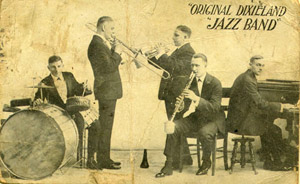
While the band has been criticized as derivative, the players have clearly absorbed the idioms — and tricks — of early African-American New Orleans jazz, and they possess an energy and vitality that gained them considerable popularity. Their early records, such as Livery Stable Blues ♫, contributed greatly to the dissemination of jazz across the country and in Europe (where they toured), helping to establish a market for New Orleans jazz. In the recording, listen for the aforementioned tricks, in particular the sounds of barnyard animals: a rooster crowing on clarinet, a horse whinnying on cornet, and a cow lowing on trombone.



Alicia Keys covered Fats Waller's "Ain't Misbehavin'" for the 2013 movie The Great Gatsby, starring Leonardo DiCaprio and Carey Mulligan.
