
Overview
In the evolution of jazz, the New Orleans and Chicago styles of the 1920s gave way to the emerging swing style of the 1930s. In this, and the next several sections, we will learn about some of the most influential jazz musicians of this era and how their musical contributions helped shape the jazz style known as swing.
Objectives
Upon completion of this lesson, you will be able to do the following:
- Identify selected swing musicians and their contributions to jazz
- Define charts
- Identify the significance of call-and-response in Fletcher Henderson's compositions, as well as in others‘
- Define antiphonal counterpoint
Coleman Hawkins
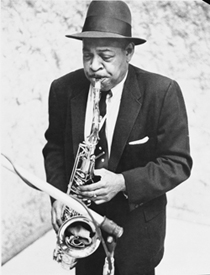
Coleman Hawkins (1904-1969) is considered the first great tenor saxophonist. He developed a warm, full sound on the instrument that was emulated by many who came after him.
A Midwesterner from St. Joseph, Missouri, Hawkins studied piano and cello as a child and by age nine had begun playing tenor saxophone. He cut his teeth as a performer in Kansas City and Chicago. In 1921, before his seventeenth birthday, Hawkins was invited to join blues singer Mamie Smith on tour, and three years later he joined Fletcher Henderson's band in New York. Hawkins stayed in Henderson's band for ten years. In 1934, he began a tour of England that resulted in a five-year stay in Europe. He was welcomed everywhere except Germany, where the Nazis had enacted laws that forbade African Americans from entering the country. In 1939, with the outbreak of war imminent, Hawkins returned to the States5.
Although the jazz landscape had changed considerably during Hawkins' five years away, his return was heralded by the jazz cognoscenti. Before long, he had reestablished himself in New York, performing and recording with his nine-piece band. While there were now competing stylistic approaches to the tenor saxophone, Hawkins demonstrated the continuing vitality of his own style6.
His recording of Body and Soul ♫ is one of those pieces acclaimed as a masterwork that has also enjoyed tremendous popularity. Hawkins solos throughout. Notice that his style of improvisation emphasizes the harmonic progression by including rapid passages outlining the notes of the chords.



"Duke Ellington wrote over 1,000 compositions in his lifetime as a Jazz band-leader, composer and pianist, including Jazz standards, film scores and classical works."
