
Overview
In the early 1940s, a number of innovative and daring jazz musicians began searching for a new style. In after-hours jam sessions, they experimented with new melodic and harmonic vocabularies that challenged listeners and musicians alike. This music would come to be known by its onomatopoeic description: bebop.
In this section, we will first focus on the two principal innovators of this new jazz style: Charlie Parker and Dizzy Gillespie. We will also discover how the swing-style jazz of Count Basie provided a basis for the transition to bebop and the advent of the modern jazz era. In the second half of the section, we will discover other influential musicians who helped shape bebop and modern jazz.
Objectives
Upon completion of this lesson, you will be able to do the following:
- Identify Charlie Parker and Dizzy Gillespie as the principal innovators who contributed to the development of bebop
- Appreciate bebop as a new approach that ushered in modern jazz
Modern Jazz
The advent of modern jazz — while revolutionary — was not quite as revolutionary as it might seem at first blush, for two principal reasons:
- The history of jazz is characterized by innovation and exploration. More than any style or genre of music that preceded it, jazz evolved rapidly.
- The specific development of bebopThe first style of modern jazz, characterized by faster tempos and more complex melodies and harmonies (or "bop"), the first modern jazz style, owes a great deal to its continuity with swing, especially the Kansas City style of Count Basie and His Orchestra.
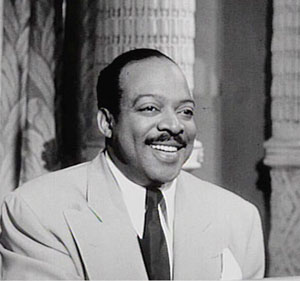
Basie's rhythm section had led swing away from the 2/4 (duple meter) rhythms that permeated New Orleans, Chicago and New York jazz toward a more relaxed swing in 4/4 (quadruple meter).
The respective roles of the rhythm section players were refined by Basie orchestra members:
- Jo Jones on drums.
- Walter Page on bass.
- Freddie Green on guitar.
- Count Basie on piano.
There was less "oom-pah" and more evenness of beats. Jones' ride rhythmsA characteristic swing rhythm played by the drummer that may be described as "ching, chick-a-ching, chick-a-ching.” on hi-hatA type of cymbal used in drumming, consisting of two cymbals mounted on a stand, one on top of the other., Page's driving quarter note walking bass, Green's steady strumming on the beat and Basie's syncopated compingA term that refers to the improvisational techniques deployed when a pianist plays the accompanying chords in a jazz setting. all anticipated the striking developments of bebop.
The linearA term used to describe a single melodic line, whether played by a horn, piano, or guitar. fluidity of Lester Young's tenor saxophone similarly anticipated developments in the art of solo improvisation. To refresh our memory, let's listen again to Lester Leaps In ♫. The virtuosic solo improvisation that we hear in this piece (courtesy of Lester Young) would soon become a hallmark of modern jazz.



Sarah Vaughan entered the talent contest at Harlem's Apollo Theater on a dare from friends. She sang her version of "Body and Soul" and won 1st prize.
