
Overview
In the early 1940s, a number of innovative and daring jazz musicians began searching for a new style. In after-hours jam sessions, they experimented with new melodic and harmonic vocabularies that challenged listeners and musicians alike. This music would come to be known by its onomatopoeic description: bebop.
In this section, we will first focus on the two principal innovators of this new jazz style: Charlie Parker and Dizzy Gillespie. We will also discover how the swing-style jazz of Count Basie provided a basis for the transition to bebop and the advent of the modern jazz era. In the second half of the section, we will discover other influential musicians who helped shape bebop and modern jazz.
Objectives
Upon completion of this lesson, you will be able to do the following:
- Identify Charlie Parker and Dizzy Gillespie as the principal innovators who contributed to the development of bebop
- Appreciate bebop as a new approach that ushered in modern jazz
Gillespie and Parker and 52nd Street
The initial response to bebop among the broader jazz audience and critics was mixed at best. But the controversy brought attention and promoted a healthy interest in the art of jazz. In the mid-to-late-1940s, as bebop gained acceptance, more and more small jazz clubs opened on 52nd Street between Fifth and Sixth Avenues, establishing "The Street" (as it was called) as the new center of jazz. Drummer Shelly Manne describes the scene:
" It was beautiful because you'd play all kinds of music. I remember one night playing with Diz at the Onyx, going across the street playing with Trummy Young at the Deuces, and then sitting in with Billie Holiday at the Downbeat. And then you could go into Jimmy Ryan's if you wanted to play. It was like a history of jazz on one street, for that time1.
It seemed for a time that Dizzy Gillespie was the only other horn player who could keep up with Bird. Gillespie had unsurpassed mastery on trumpet. His agility was a match for Parker's, and his high register playing was astonishing. Through the 1940s and 1950s, Charlie Parker provided the model for aspiring saxophonists as Dizzy Gillespie did for trumpeters.
Dizzy also provided an appealing persona as a representative of the new jazz style. In addition to his extraordinary performance ability, he was also a consummate showman and entertainer — talents that served him well in a long and prosperous career.
Let's watch and listen now to a video clip providing a more intimate view of Dizzy Gillespie during the early years of bop.



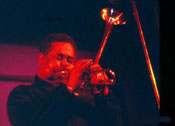
Dizzy Gillespie played his trumpet with the bell turned upwards at a 45-degree angle. Gillespie discovered he liked the sound that it created after someone fell on his trumpet stand causing the bell to bend.
