
Overview
In this section, we will focus on the late 1950s and early 1960s to learn more about Miles Davis and two of his most influential sidemen: Bill Evans and John Coltrane. We will consider the significance of Davis' musical compositions and those of his fellow musicians, and examine how their works continue to impact jazz even to the present day.
Objectives
Upon completion of this lesson, you will be able to do the following:
- Identify many of the contributions of Miles Davis to jazz
- Define modal jazz
- Recognize the contributions of Bill Evans to jazz—most especially to jazz piano
- Recognize the contributions of the members of Bill Evans’ most celebrated trio
- Recognize the contributions of John Coltrane as saxophonist, composer and bandleader
- Recognize the contributions of the members of John Coltrane’s classic quartet
Pedal Points
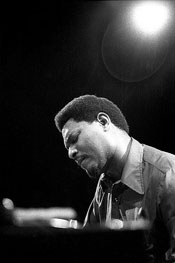
Another piece from the Giant Steps album, the ballad Naima ♫, is often cited as one of Coltrane's loveliest. Two years after the studio session, Naima ♫ was recorded live at the Village Vanguard in New York City. Sharing the front line with 'Trane that evening was Eric Dolphy, playing bass clarinet. (We will hear more from Eric Dolphy in the next lesson.) McCoy Tyner was playing the piano.
Naima ♫ features a pioneering technique in jazz that would mark a significant number of Coltrane's works — the use of pedal pointsA repeated or sustained note, usually in the bass, over which the melody and harmonies move..
A pedal pointA repeated or sustained note, usually in the bass, over which the melody and harmonies move. is a repeated or sustained note, usually in the bass, over which the melody and harmonies move. The effect of a pedal point is much like a drone; it grounds the activity above it and helps to unify the musical fabric.
In some respects, it is a modal style of jazz — not exactly the same sort explored by the Davis sextet, but there are similarities between them.
Before we hear Naima ♫, let's consider a more straightforward use of pedal point in another Coltrane piece.
Listen to the opening of Alabama ♫ and the use of a single pedal point. Notice the tremolo sound of the piano and bass, creating the low sustained pitch of C. This is the pedal point we hear through this opening section.
In Naima ♫, Coltrane uses two pedal points:
- The first one, E-flat, is played for the first eight bars;
- The second one, B-flat, for the next eight bars.
Because the piece is in the keyA term that indicates the musical scale and the musical note around which a composition is harmonically centered of A-flat, the pedal points — which are on the 5th and 2nd notes of the scale — help to maintain a tension and expectation throughout the piece. In a very real sense, the listener is waiting — consciously or subconsciously — for the resolution to the tonic chord (I), which finally arrives at the end of the piece.
Coltrane plays the slow head-melody to introduce Naima ♫, then — uncharacteristically, for Coltrane — yields the solo honors to Dolphy and Tyner before wrapping it up with a restatement of the tune.
Listen now to John Coltrane's Naima ♫, recorded live at the Village Vanguard.



A pedal point can also be called a pedal tone, pedal note or an organ point. It is called "pedal" point referring to the notes sustained by using the pedals on an organ.
