
Overview
In this section, we will focus on the late 1950s and early 1960s to learn more about Miles Davis and two of his most influential sidemen: Bill Evans and John Coltrane. We will consider the significance of Davis' musical compositions and those of his fellow musicians, and examine how their works continue to impact jazz even to the present day.
Objectives
Upon completion of this lesson, you will be able to do the following:
- Identify many of the contributions of Miles Davis to jazz
- Define modal jazz
- Recognize the contributions of Bill Evans to jazz—most especially to jazz piano
- Recognize the contributions of the members of Bill Evans’ most celebrated trio
- Recognize the contributions of John Coltrane as saxophonist, composer and bandleader
- Recognize the contributions of the members of John Coltrane’s classic quartet
The Classic Coltrane Quartet
1960 and 1961 saw various lineup changes in the makeup of Coltrane's combos. However, by 1962, he had settled on the members of his quartet: McCoy Tyner on piano, Jimmy Garrison on bass, and Elvin Jones on drums. For the better part of the next three years, the quartet performed and recorded, producing Coltrane's most highly regarded work as a bandleader.
Coltrane's sidemen were not well known when he recruited them for his quartet. Much like Miles Davis, though, Coltrane had an eye (and an ear) for talent.
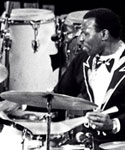
Elvin Jones (1927-2004) soon came to be regarded as one of the most innovative drummers in all of jazz history. The power and complexity of his playing were integral to the quartet's broad, surging sound. He is especially known for his ability to play intricate polyrhythms while still maintaining a loose swing feel.
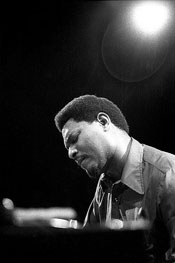
McCoy Tyner (b. 1938) developed a unique piano style based on his use of chords voiced in fourths; that is, stacking notes using the interval of a fourth, rather than the customary interval of a third.
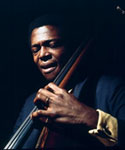
Jimmy Garrison (1934-1976) was a solid bass player with a large, full tone. He was an excellent timekeeper and had a strong intuitive feel for how to mix creatively with the rhythmic activity of Jones and the melodic excursions of Coltrane.



Rolling Stone rated Miles Davis' "Kind of Blue" 12th of the 500 Greatest Albums of All Time, calling it "one of the most important, influential and popular albums in jazz"
