
Learning Objectives
- Examine the two most widespread musical genres of Native North America: traditional music associated with specific tribes, and intertribal music, which can be performed by Native people regardless of their tribal affiliation.
- Analyze how the creation and performance of music and dance has played an essential part in the lives of North America's indigenous peoples since their beginnings on the continent. examine the instruments used in Native North American music, such as drums, rattles, and flutes.
- Extrapolate how Native peoples in the Americas continued to perpetuate their music and dance traditions through old ceremonies and new songs, despite the devastating impact of European settlement.
- Examine the role of contemporary Native Americans in participating in age-old religious rituals, dancing in intertribal celebrations, singing native-language hymns in church, and listening to the latest in Indian country, rock, and hip-hop music.
- Identify Native American music broadly, including "classical" music by Native composers (such as symphonies and ballets), Christian hymns, and popular music.
- Examine intertribal music (sometimes known as "Pan-Indian" music), such as pow-wow and flute music styles, that came from the sharing of tribal-specific traditions with others.
Musical Instruments I
Because of the diversity of native cultures in North America, it is impossible to present a generic "Indian" world view.
Native North American peoples, however,do hold many shared concepts about music and dance. For example, common to most Indian societies is the belief that musical instruments are living beings brought to life when created, and worthy of care and respect.
The most common instruments used in both tribal-specific and intertribal music are drums, rattles, and flutes.
Drums
In many parts of the Great Plains and Woodland regions, "drum houses" are still made for drums to inhabit, and when played the instruments are honored with tobacco, eagle feathers, and other gifts. Concepts surrounding the nature of drum sounds are complex as well: They may be as simple as a basic beat for dancing, or anchored in the belief that sounds produced by a drum transcend the boundaries of time and the physical universe, mediating between the spiritual realm and our own.
In the Great Lakes region, the Midewiwin religion of the Anishnaabeg "Three Fires" confederacy (made up of the Ojibwe, Ottawa, and Potawatomi nations) teaches that the world was made from sound that slowly congealed into a solid object (the Earth). One of their ceremonies employs a copper sheathed shaker played by a woman in conjunction with a gourd shaker played by a man, opening a door into the past, and bringing to the present the sound heard in the great void before the earth was created.
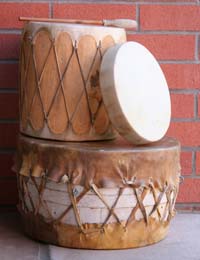
The photo at the right shows three different types of drums, including a large pow-wow (or "big" drum, bottom), a taller Pueblo-style drum (usually worn with a strap, upper left), and a hand drum (Arapaho, upper right).



In Native American cultures, the roles of music and dance are connected with ceremonial rituals.
