
Overview
Objectives
- Examine some of the musical characteristics of the earliest rock and roll hits and how these musical genres relate to earlier genres studied in the previous lessons such as blues, gospel music, rhythm and blues, and hillbilly music
- Describe the technological changes and its impact in the music industry
- Examine the influence of disc jockey Alan Freed
- Identify various rhythm and blues artists
- Examine some of the ways that white artists modified the music of black artists in their cover versions
New Technologies and Means of Consumption
The magnetic recording process completely changed how music was recorded and distributed. Developed by the Germans to guide their radio-controlled V-2 bombs, the magnetic tape recorder recording on magnetic tape allowed for sound to be recorded, erased, and re-recorded on the same tape many times, allowed for recordings to be duplicated from tape to tape, allowed for recordings to be edited, and made recording much less expensive revolutionized the music industry. Recording was no longer confined to gigantic and elaborate studios owned by the major companies in a few big cities. Tolerably decent recordings could now be made anywhere, at any time of the day, by untrained personnel who knew very little about engineering or acoustics.
Around the same time, hi-fi 45 RPM a record that plays at 45 revolutions per minute and had a limit of around three to four minutes of sound per side (45 revolutions per minute) technology exploded onto the scene. Peter Goldmark, the head of CBS labs for many years, had invented high fidelity ("hi-fi"), and the 33-1/3 RPM process way in the 1930s. He was designing phonograph equipment to handle the remarkable new product when the war broke out, so everything was therefore put on hold for a few years. After the war, when CBS made its move to 33-1/3 RPMs, RCA countered with a 45 RPM record, and it immediately invented a small, economical 45 RPM playback unit. CBS then caught up by making a three-speed turntable with an adapter for the 45 RPM option. The result of this corporate warfare was a huge jump in pop singles. 45-RPMs were small, less expensive to produce, and less expensive for consumers to purchase. It was in the world of 45 RPM singles (two sides, the favored one called the A side, and the often throwaway gesture called the B side) that rhythm and blues had its first great moment in pop music history.
About the same time, several new types of electric keyboard instruments appeared. The Hammond B-3 organ’s basic sound was created by small discs rotating through a magnetic field. That sound was amplified through a slowly rotating Leslie speaker. The player’s right foot controlled the dynamics with a large pedal about the size of an accelerator on a truck. Down near the player’s left foot was an octave pedal board. The Fender Rhodes electric piano also appeared about the same time. Harold Rhodes invented the piano when he needed more instruments for therapeutic music lessons he was giving to wounded military men. He took some spare hydraulic parts from an old B-17 bomber and fashioned a working piano. The first Fender Rhodes electric pianos fit on a hospital tray so the men could practice without getting out of bed.
Music listening and consumption was also affected by the radio. The transistor radio, developed by Bell Laboratory in 1947, appeared on the market in the early 1950s. About the same time, the car radio became an affordable option in the automobile industry, and people began listening to the radio in their cars as well as in their homes. By the late 1940s and early 1950s, many popular talk, drama, and comedy radio programs had moved from radio to television, and radio programmers needed to find new material to fill the airtime. Several innovations in radio programming arose, the most important of which was the development of the Top 40 radio format.
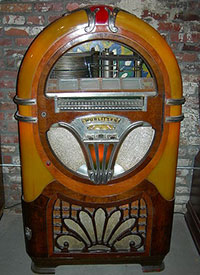
Top 40 a radio format where the same forty tunes were repeated once every 24-hour radio cycle became the new radio format. The same forty songs would be repeated every 24-hour radio cycle, and the top ten songs would receive more frequent play than the bottom thirty. In addition, Top 40 radio integrated short new spots, contests, promotional gimmicks, and frequent station identification spots by talkative disc jockeys speaking the language of the teenage listening market. Why forty tunes? Because the Wurlitzer jukeboxes, which flooded the industry at the time, contained forty recordings.



"Ray Charles was given a star on the Hollywood Walk of Fame in 1981, and was one of the first inductees to the Rock & Roll Hall of Fame in 1986."
