
Overview
Around the turn of the twentieth century, several styles and genres of music came together, and the city of New Orleans provided the catalyst for the formation of jazz. The earliest style of jazz, and one that remained popular for decades after its inception, was called Dixieland. Dixieland, like other types of jazz, allows us the chance to look at many issues of musical, racial, and commercial issues in the first quarter of the twentieth century.
Objectives
- Examine the predecessors of jazz and the diversity of styles and genres that combine in order to create the earliest jazz
- Identify the instruments, musical form, and performance style of Dixieland jazz
- Examine how the issues of race affected the earliest commercial distributions of jazz
- Identify the key figures and songs in Dixieland jazz
Key Figures in Dixieland Jazz
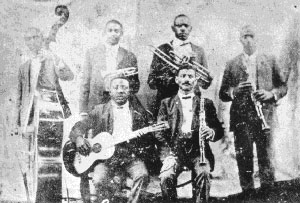
Perhaps the first major jazz musician was Charles "Buddy" Bolden, and he was often called "King Bolden." Observers claimed that, on a quiet night, you could hear Bolden’s horn playing from twelve miles away. His brilliant tone and constant improvisation were hallmarks of his style. Bolden did not call the music that he played "jazz" because that term had not come into common use yet; instead, he and other early performers of this style called their music "ragtime."
Bolden played a style of music that was less structured than ragtime, though, because his music contained more improvisation and more elements of the blues (such as blue notes) than true ragtime music did. Plagued by schizophrenia and alcoholism, Bolden spent his last twenty-four years in an insane asylum and never played his instrument again after 1907. Bolden supposedly recorded several cylindrical discs of his playing, but none of them survives.
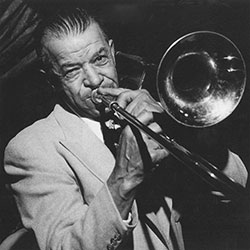
Edward "Kid" Ory organized his own band at age fifteen and was on the road by age fifteen. He played saxophone, piano, banjo, bass, guitar, trumpet, clarinet, and drums, but it was as a splendid "tailgate trombonist" and band leader that he made his mark in the world of jazz. He worked with, and hired personnel for, his own bands, the best jazz men in New Orleans. In 1919, he made some of the first jazz recordings in history by a black group of musicians. He settled in Chicago, later, and played on some of Louis Armstrong’s Hot Five and Hot Seven recording dates. Kid Ory was noted for a big, robust tone, and a strong rhythmic Dixieland trombone style. He frequently employed smearstechnique of trombone playing where the player slides through several pitches, or slides through several pitches. His most famous composition is "Muskrat Ramble ♫," widely acknowledged as a jazz classic.
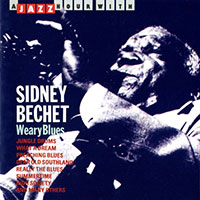
Sidney Bechet, one of the first great soloists in jazz history, was a profound influence on later saxophonists. Bechet played clarinet, as he was a Creole of color with an orchestral background. As a jazz musician, he was known for his ability to "double-time." Bechet could play a slow tune at twice the tempo while maintaining the same duration of time for the chord changes. Bechet also created dramatic intensity by preceding certain central notes in his improvised lines with various scoops, smears, and ornaments which drew attention to those important notes and placed an emphasis on tone color and timbre.
Ferdinand "Jelly Roll" Morton was a flamboyant and fascinating figure in early jazz as well. Jelly Roll was a minstrel show comedian, a pool hustler, a hotel-club owner, a boxing promoter, a cosmetics business entrepreneur, a music editor, and a recording executive. But, Jelly Roll Morton the pianist and composer is the one most important figures in jazz history. At age seventeen, he was kicked out of his house for playing piano in the New Orleans bordellos. After that point, he spent every waking minute performing, composing, and recording as solo pianist and bandleader.
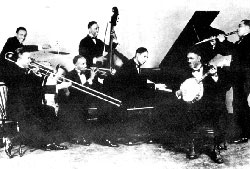
Morton claimed that he "invented jazz," which was one of his many exaggerations, of course, although his claim is not entirely untrue.
He was among the first musicians to make written "arrangements" of tunes, to alter a phrase here and there, to add an interlude, prescribe who would do what in which order, and then write down the result in music notation. Of course, these written arrangements could then be sold as sheet music in the tradition of Tin Pan Alley. His Chicago-era recordings, which are now valuable collectors' items, place Jelly Roll Morton and His Red Hot Peppers among the greatest of all studio jazz groups. Several generations of jazz musicians have been inspired by Morton originals such as "Black Bottom Stomp ♫." His solo piano recordings of "King Porter Stomp ♫" and "Tiger Rag ♫" are, likewise, ranked among the great moments in recorded jazz history. When Morton’s career began to fade in the late 1930s, folklorist Alan Lomax brought him to the Library of Congress to record 116 sides of performing and reminiscing.



