
Overview
In the 1920s, a new type of jazz emerged that was related to, but separate from, Dixieland. Called swing or big band, this music often had less improvisation, more dancing, and more instruments than its Dixieland counterpart. Led by bandleaders such as Duke Ellington, Benny Goodman, and Fletcher Henderson, swing bands provided the soundtrack for dancing and merrymaking during what were becoming increasingly difficult times in the United States.
Objectives
- Recognize the difference between swing music and Dixieland jazz such as instrumentation, form, purpose, and composition
- Examine how race relations affected the performance and recording of swing music throughout the 1930s and 1940s
- Identify various bandleaders and the way each cultivated a specific style within their individual groups such as Count Basie’s Kansas City swing style
Big Bands
By the middle of the 1920s, several bands began breaking out of the mold of the society syncopators. These bands provided music that could be danced to, but the music was more innovative and increasingly driven by soloists and arrangers. Various mixtures of instruments appeared in these ensembles, but generally a big band consisted of piano, string bass, guitar, and a set of drums in the rhythm section; 1st, 2nd, and 3rd trumpets, with the 2nd trumpet playing the "hot" or jazz solos; 1st and 2nd trombones; and 1st alto, 2nd tenor, 3rd alto, and 4th tenor saxophones, with the 2nd tenor being the "hot" or jazz soloist. This instrumentation settled down to become the generic model by the middle of the 1930s.
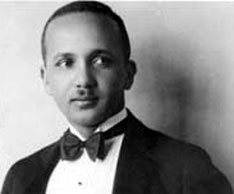
Fletcher Henderson arrived in New York from Georgia to be a research chemist and to pursue graduate studies at Columbia University. He accepted a pianist’s position with Henry Pace’s Black Swan Phonograph Company, which exclusively produced race records. At Pace’s suggestion, Henderson formed a band to tour with the singer Ethel Waters to promote her slow-selling Black Swan discs. After the tour, he returned to New York and a full-time career as pianist-arranger-bandleader. He hired the best musicians in the business to play in his ensembles, often college graduates who could read music fluently and who played several instruments. He rehearsed them carefully on his interesting modern arrangements.
Henderson and his lead alto saxophonist and fellow arranger, Don Redman, invented the vocabulary, grammar, and syntax of the big band’s musical language. Over a strong four-four rhythmic pulse, the brass instruments and saxophones would exchange musical passages, often followed by unison riffs behind improvised solos. Quick modulations and clever interludes provided variety. The piece would then be all wrapped up with a swinging full-band final out-chorus. This powerful and exciting new style of jazz soon became the prevailing popular music in the United States. Henderson suffered serious injuries in an automobile accident in 1928, and his productivity as a bandleader was seriously limited. Benny Goodman put Henderson on the payroll as staff arranger, and many of Goodman’s huge hits came from Henderson, including "King Porter Stomp ♫," and "Blue Skies ♫."
Duke Ellington went to New York, and from 1923 to 1927 his band, the Washingtonians, packed the Hollywood Club at Broadway and 39th Street. When he moved to the Cotton Club in 1927, he increased the band’s size to fourteen members, and he achieved to international fame with his imaginative arrangements and original compositions. During the first decade of his career, Ellington explored the instrumental colors of the jazz orchestra. During his time leading the orchestra at the Cotton Club, Ellington explored the instrumental colors of the jazz orchestra. Ellington’s orchestra featured the muted trumpet growls of Bubber Miley and Cootie Williams, and the liquid beauty of alto saxophonist Johnny Hodges, and the clever licks of trombonist Joe "Tricky Sam" Nanton. Ellington also encouraged his musicians to use a variety of mutes to produce creative tone colors and timbres.
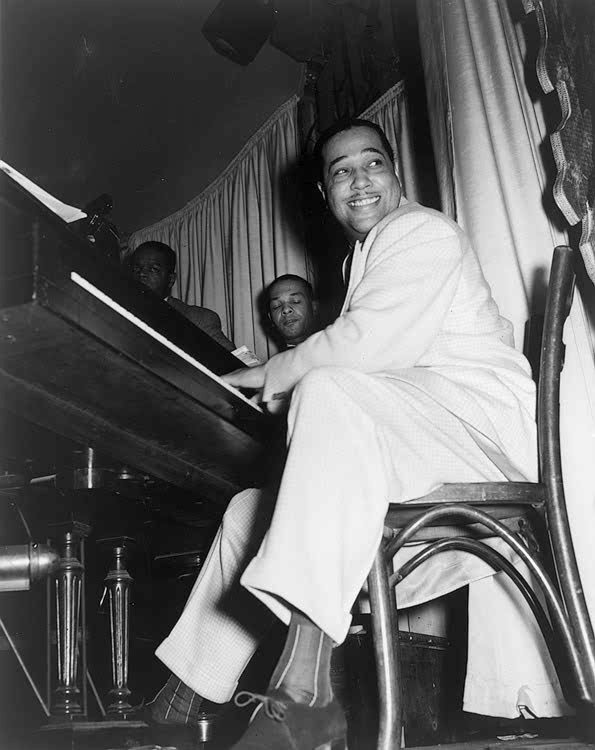
These new sounds caught the attention of journalists, who began calling them "jungle sounds," a term that suggests primitive, animalistic behavior. Critics and white audiences at the time often attributed negative racial stereotypes to black musicians, their music, and the effects their music produced on listeners and dancers. Publicity material for the Cotton Club shows frequently used the term "jungle music." Although Ellington did not necessarily view his music in the sense of these primitive or animalistic terms, he did value tone color and timbre. In Ellington’s compositions, he frequently sought new and interesting sounds, which he created by combining and recombining groups of instruments, encouraging his musicians to create special effects, and focusing on the soloists. Many of Ellington’s compositions from this period feature long instrumental solos by a single musician, which allowed that musician to shine. Ellington frequently wrote compositions with a specific soloist in mind. Often times, these pieces included the musician’s name in the title, such as Concerto for Cootie ♫, written for Cootie Williams, or Jeep's Blues ♫, for Johnny Hodges.
Old Man Blues ♫ is a typical Ellington number from this era, and both the piece and Ellington’s orchestra were featured in the 1930 film Check and Double Check. Even though the piece has "blues" in the title, the 12-bar blues are nowhere to be found in the form. Instead, Ellington freely composed the form of the piece. Old Man Blues ♫ is particularly remarkable in its attention to tone color, which, as we recall from earlier lessons, was extremely important in African American music genres such as the blues and Dixieland jazz. In Old Man Blues ♫, musicians use a variety of mutesin order to manipulate the sounds of their instruments. The most memorable technique is that of the plunger mute, which produces a sound very much like that of wordless, "wa-wa" singing. (The voice of Charlie Brown’s teacher in the old Peanuts cartoon show was created by using a trombone with a plunger mute.) The solos in this piece are shorter and more diverse than in many of Ellington’s works; other Ellington pieces may feature a single soloist for many measures, but Old Man Blues ♫ is primarily made of short solos with instrumental riffs.




