
Learning Objectives
- Outline the social, cultural, and political impact of WWI and WWII.
- Discuss the growth of the United States as a world power.
- Describe the impact of technological advancements on the development of music in the twentieth century.
- Describe, compare and contrast the main stylistic differences of Contemporary music styles including impressionism, post-Romanticism, serialism, and expressionism.
- Summarize the changing nature and application of the concept of tonality throughout the century.
- Discuss the impact of Claude Debussy's "Prelude to the Afternoon of a Faun" in light of the Symbolist movement in literature.
- Illustrate how the Russian composer Igor Stravinsky experimented with rhythm, new instrumental combinations, and the percussive use of dissonance, and discuss the impactof these techniques on contemporary music.
- Describe the impact of Arnold Schoenberg and the Second Viennese School on 20th-century music.
- Distinguish the main stylistic differences of nineteenth- and twentieth-century composers and styles.
- Describe the musical and political impact of “national schools” of composition that developed across Europe during the 20th century.
- Explain the impact of composer Aaron Copland on American contemporary music.
- Describe the impact of Latin American composers on the larger "art music" scene and repertoire.
- Define and analyze the main differences between jazz, ragtime, and blues.
Music of the 20th and 21st Centuries (1900-Present)
Currents in the New World: United States
Aaron Copland
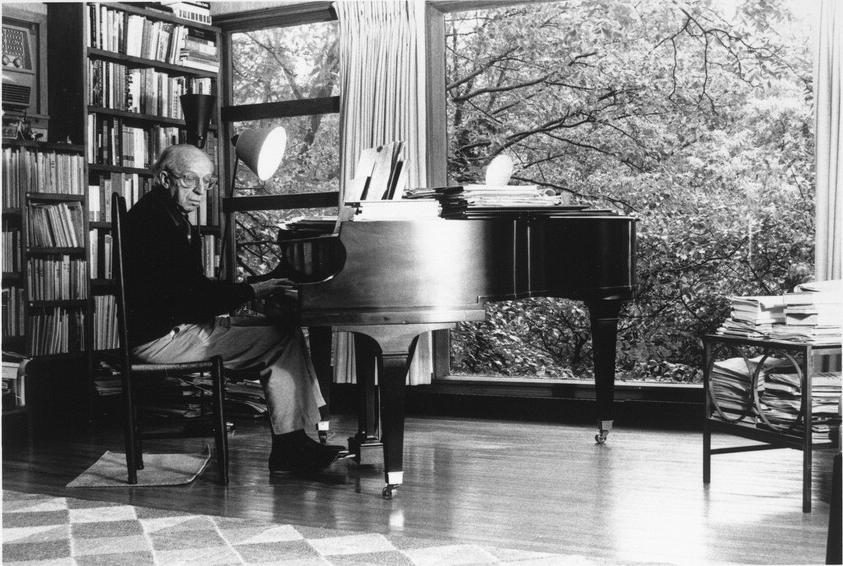
During the mid-20th century in the United States, several composers strove to create an American sound while working within the bounds of the European classical tradition. Asked to name the most "American" of all American composers (leaving out jazz and related genres), many would name Aaron Copland. He is often referred to as "the Dean of American Composers." Works such as Fanfare for the Common Man(1942), Rodeo (1942), and Appalachian Spring (1944) have embedded themselves in world consciousness as aural symbols of the United States. His use of chords with open fifths, American folk melodies , and countless fiddle tunes evoke the open spaces of the American frontier.
Composer: Aaron Copland
-
"Fanfare for the Common Man"
Composer: Aaron Copland
-
"Rodeo: Hoe-Down"
Composer: Aaron Copland
-
"Appalachian Spring"
Composer: Aaron Copland
-
"Rodeo: Hoe-Down" [ 00:04-00:15 ]00:11
Composer: Aaron Copland
-
"Appalachian Spring" [ 16:38-17:06 ]00:28
Composer: Aaron Copland
-
"Rodeo: Hoe-Down" [ 00:44-01:32 ]00:48
Jazz, that most American of musical expressions, was a source of inspiration in his Piano Concerto (1926), a work commissioned by Sergey Koussevitzky and the Boston Symphony.
Composer: Aaron Copland
-
"Piano Concerto: II. Molto moderato – Allegro assai"
Later, he even adapted serial techniques to his own compositional style, as we can hear in "There came a wind like a bugle" from Twelve Poems by Emily Dickinson (1950). Aside from his orchestral works, Copland was active in many other genres including chamber music, opera, vocal works, and film scores throughout his life.
Composer: Aaron Copland
-
"Twelve Poems by Emily Dickinson: "There came a wind like a bugle""
Some of Copland's early songs show the influence of European music. In the impressionist "Night," we can hear Claude Debussy with his whole-tone scales, while Richard Strauss seems to be the model for "My Heart is in the East."
Composer: Aaron Copland
-
""Night""
Composer: Aaron Copland
-
""My Heart is in the East""
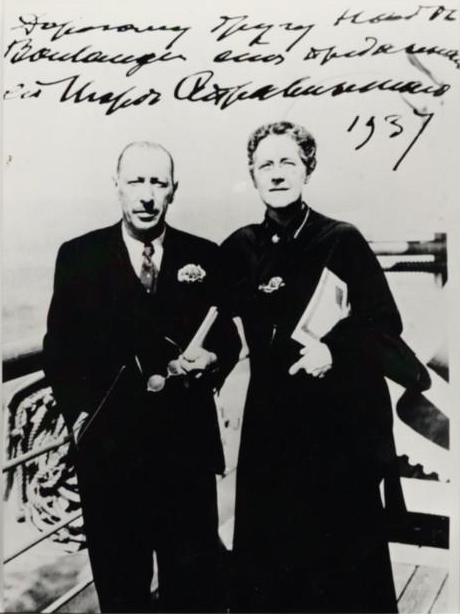
Copland was born in Brooklyn, New York, to a Lithuanian Jewish family whose name was originally Kaplan. He decided to become a composer at the age of fifteen. His attraction to the contemporary music of Europe drew him to Paris in 1922. There, he became the first American pupil of the famed teacher Nadia Boulanger (1887–1979), who later taught many of the leading American music figures of the 20th century. Copland later stated to her in 1950: "I shall count our meeting the most important of my musical life...Whatever I have accomplished is intimately associated in my mind with those early years, and with what you have since been as inspiration and example."
After this intense period of apprenticeship spent in France, he returned to the United States in 1924, and as Stravinsky, Ravel, and others in Europe did, Copland began to incorporate jazz elements in his music. In "Dance of Mockery," the last movement of his Dance Symphony, listen for the initial angular theme for woodwind and percussion followed by a rhythmically incisive theme for strings and brass. This theme later alternates with an ironic idea featuring glissando strings, before the trombone motif from the work's beginning mixes up all of the material. A whirlwind of activity ends the piece with a decisive thud.
Through his activity at the Yaddo artist colony in Saratoga Springs (NY), Copland influenced the careers of other young American artists, including such important figures as Virgil Thomson, Leonard Bernstein, Philip Guston, Truman Capote, and Philip Roth. He also formed a group called the "commando unit," which included fellow composers Roger Sessions, Roy Harris, Virgil Thomson, and Walter Piston. The group collaborated in joint concerts that exposed their work to new audiences. Ironically, this most American of American composers was put on trial in the 1950s for allegedly not being American enough. Senator Joseph McCarthy, in his campaign against perceived Communist infiltration of the United States, questioned Copland's participation in cross-cultural exchanges with Soviet composers such as Shostakovich. Though just eight years earlier he had received the Pulitzer Prize for his ballet Appalachian Spring, Copland was ordered to appear before the House Un-American Activities Committee. As a result, for several years Copland found it difficult to obtain a passport to travel and was shunned by some public personalities. Gradually he was restored to the good graces of Congress and general opinion, and in 1986 he received the Congressional Gold Medal for his "uniquely American music that reflects the very soul and experience of our people."
Appalachian Spring premiered in 1944 at the Library of Congress in the Coolidge Auditorium. The work had been commissioned by the foundation of Elizabeth Sprague Coolidge (1864–1953), one of the most significant music patrons in America. Copland's ballet was scored for just 13 instruments—flute, clarinet, bassoon, piano, and strings—because no more would fit in the orchestra pit. The "mother of modern dance," Martha Graham, choreographed the ballet and danced the lead role.
In fact, at first Copland's had titled the piece Ballet for Martha. The subject matter evolved along with the choreography, and the title was only applied (by Graham) at the last moment. Appalachian Spring became the story of a pioneer celebration in Pennsylvania in the early 1800s. In the narrative, a farmhouse has been built for a young couple, and neighbors and a revivalist preacher offer their good wishes and advice. The music features a square dance, hymn-like melodies, and the now well-known Shaker song "Simple Gifts."
The following year (1945), Copland extracted from the ballet an orchestral suite in eight sections for concert hall performance. Follow the Listening Guide as you listen to sections 2 and 7 below. The orchestration is for two flutes and piccolo, two oboes, two clarinets, two bassoons, two horns, two trumpets, two trombones, timpani, long drum, glockenspiel, triangle, wood block, xylophone, snare drum, bass drum, cymbals, harp, piano, and strings.
Composer: Aaron Copland
-
"Appalachian Spring" [ 02:13-03:34 ]01:21
Composer: Aaron Copland
-
"Appalachian Spring" [ 16:38-19:43 ]03:05
During the 30s, 40s, and 50s, inspired by the ideals of German Gebrauchsmusik ("utility music") Copland created American "music for use." The aim was to create works that served utilitarian as well as artistic purposes and had wide public appeal. Aside from Rodeo (1942), and Appalachian Spring (1944) mentioned above, music from this period includes incidental music for special occasions, plays, movies, and radio, as well as his best-known ballet scores: El Salón Mexico (1936) and Billy the Kid (1939). These works were to American music much what Stravinsky's had been for Russian music.
Composer: Aaron Copland
-
"Billy the Kid"
From the 1960s until the end of his life, Copland concentrated on conducting and recording rather than composing. "It was exactly as if someone had simply turned off a faucet," he famously remarked, referring to his creative powers. Over the course of an exceptionally active career, Copland's achievements won him all kinds of awards in the U.S. and abroad, from the Pulitzer Prize in 1945 to the Order of Merit of the Federal Republic of Germany in 1970. He died of Alzheimer's disease and respiratory failure on December 2, 1990 in North Tarrytown, New York (now Sleepy Hollow). Much of his large estate was bequeathed to the creation of the Aaron Copland Fund for Composers, which bestows over $600,000 per year to performing groups.