
Learning Objectives
- Outline the social, cultural, and political impact of WWI and WWII.
- Discuss the growth of the United States as a world power.
- Describe the impact of technological advancements on the development of music in the twentieth century.
- Describe, compare and contrast the main stylistic differences of Contemporary music styles including impressionism, post-Romanticism, serialism, and expressionism.
- Summarize the changing nature and application of the concept of tonality throughout the century.
- Discuss the impact of Claude Debussy's "Prelude to the Afternoon of a Faun" in light of the Symbolist movement in literature.
- Illustrate how the Russian composer Igor Stravinsky experimented with rhythm, new instrumental combinations, and the percussive use of dissonance, and discuss the impactof these techniques on contemporary music.
- Describe the impact of Arnold Schoenberg and the Second Viennese School on 20th-century music.
- Distinguish the main stylistic differences of nineteenth- and twentieth-century composers and styles.
- Describe the musical and political impact of “national schools” of composition that developed across Europe during the 20th century.
- Explain the impact of composer Aaron Copland on American contemporary music.
- Describe the impact of Latin American composers on the larger "art music" scene and repertoire.
- Define and analyze the main differences between jazz, ragtime, and blues.
Music of the 20th and 21st Centuries (1900-Present)
Currents in the New World: United States
John Cage
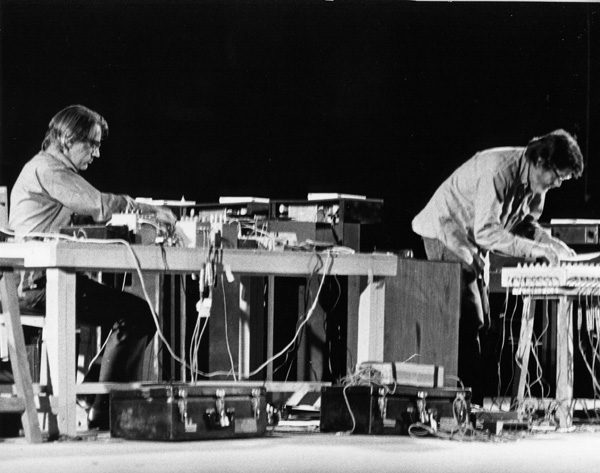
John Cage, "an inventor of genius" according to his teacher Schoenberg, was one the most controversial and influential American composers of the twentieth century. His first works dating from the 1930s were based on the twelve-note (or serial) technique, a method of composing that Schoenberg had introduced in the previous decade.
Cage never stopped posing the question "What is music?" His most famous work is probably 4'33", in which the performer looks at a blank score for four minutes and thirty-three seconds, turning the pages at specified intervals. The resulting sounds in the room (shuffling feet, coughs, and murmurs of disbelief) become the composition, a work that the composer "created" but over which he has no control.
Cage was an extremely hardworking and prolific composer, so while this piece represents his intense questioning, it does not fairly represent his output. In 1946, strongly influenced by his study of Indian philosophy with Gita Sarabhai and of Zen Buddhism with Daisetz T. Suzuki at Columbia University in New York, he developed a compositional esthetic that relinquished control and purpose, and thus he became one of the first composers to experiment heavily with aleatory music, also known as "indeterminacy." As previously mentioned in the text, aleatory music brings an element of chance into a composition, whether through a performer's improvisation or a composer's design. Cage rolled dice, flipped coins, and superimposed notes on maps of the sky in order to create compositions. Audiences were not always amused. Only later in his life did he receive accolades for his bold experiments.
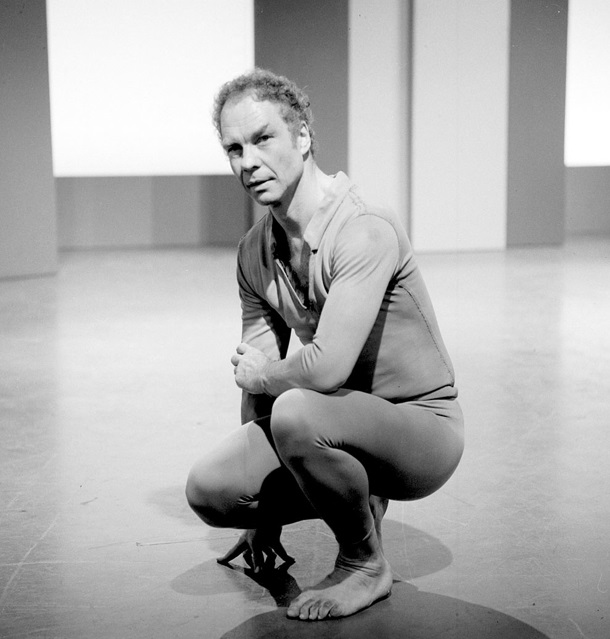
Throughout the 1940s, Cage explored in particular the possibilities of various kinds of percussion, electronic sound, and "prepared piano." A prepared piano has rubber bands, pieces of leather, screws, or other objects fitted to its strings so that they produce a different timbre. Cage was not the first to work with prepared pianos, nor was he the last: experiments continue today, including playing on the inside of the piano and on its wooden case. In 1943, Cage composed the Amores, four pieces for prepared piano and percussion. Follow the Listening Guides as you listen to No. 1, Solo for prepared piano, and No. 3, Trio for 7 wood blocks. The piano is prepared using 9 screws, 8 bolts, 2 nuts, and 3 strips of rubber. In 1949, his artistic and life partner Merce Cunningham choreographed dances for the first and fourth movements of the Amores.
Composer: John Cage
-
"Amores: I. Solo for prepared piano"
Composer: John Cage
-
"Amores: III. Trio for 7 wood blocks"
In his own words...
"Schoenberg said I would never be able to compose, because I had no ear for music; and it's true that I don't hear the relationships of tonality and harmony. He said: 'You always come to a wall and you won't be able to go through.' I said, well then, I'll beat my head against that wall; and I quite literally began hitting things, and developed a music of percussion that involves noises."
John Cage, interview in the Observer Magazine, 1982