Overview
The history of jazz rightly begins in the city of New Orleans. In this section, we will learn about great New Orleans jazz musicians and their early recordings in Chicago. In the process, will also learn about the emerging Chicago jazz scene and some of the artists from that area who helped develop early jazz musical styles. Finally, we will do a short overview of early jazz in New York.
Objectives
Upon completion of this lesson, you will be able to do the following:
- Define collective improvisation
- Identify early jazz musicians and their contribution to jazz music
- Appreciate the significance of Dixieland jazz
- Recognize the impact Chicago had for musicians of early jazz
- Recognize the growing importance of New York for further developments in jazz
- Define chord substitutions
Struttin' With Some Barbecue
Struttin' with Some Barbecue ♫ exhibits a characteristic form in jazz known as A A' formA standard form in American song and in jazz, frequently 32 bars in length and divisible into two subsections. At the halfway point, this form returns to its familiar opening material.(pronounced "A A prime form"). It is often a 32-bar form, as it is here, and each of the larger 16-bar sections may be further divided into 8-bar subsections. In that regard, it shares much in common with 32-bar song form. The big difference between the two forms is at the midway point: in song form, the contrasting B section — the bridge — begins the second half of the form, whereas in an A A' form, the second half of the form begins with a return to the opening material.
The contrasts in A A' form exist principally between the two 8-bar subsections in both 16-bar halves of the form. Characteristically, in an A A' form, smaller letters could represent the 8-bar subsections, with the A section broken down as a b and the A' section as a b'.
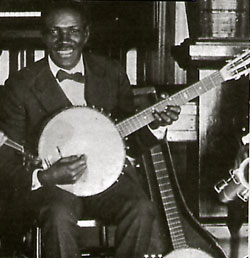
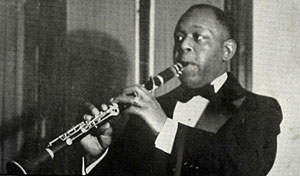
Notice the classic New Orleans sound of collective improvisationA characteristic feature of New Orleans jazz in which multiple instrumentalists improvise together according to agreed-upon conventions. through the first chorus, as the cornet carries the melody. At the turnaroundThe last two bars of a phrase or chorus in which the standard rhythmic and melodic patterns are abandoned to allow a freer and more virtuosic expression by various instrumentalists, often drawing attention to the drummer. at the end of the first chorus, there is a breakA point in the music, normally at the turnaround, when all the instrumentalists except one stop playing, allowing that one performer to begin or end a solo improvisation with a virtuosic flourish. — that is, a point in the music when everyone stops playing for one or two bars, except for a soloist. Most often, this will allow the soloist to enter very dramatically. In this case, the banjo player Johnny St. Cyr simply fills the turnaround before Johnny Dodds enters on clarinet to take a solo through the first half of the second chorus.
There's another break at the next turnaround, midway through the second chorus, providing Dodds a spotlight as he wraps up his solo, before Kid Ory makes his entrance on trombone to solo through the second half of the chorus. Ory receives a similar break at the turnaround for the end of his solo. Then Satchmo (as Armstrong was known) takes command with an exuberant, masterful solo over an entire chorus. Notice the way in which St. Cyr on banjo creates a backbeatA rhythmic accent on the weak beats in a measure, typically beats 2 and 4. by strumming only on beats 2 and 4, thus providing more space for the soloist. The virtuosic manner in which Armstrong fills the break at the midway turnaround provides yet another stellar benchmark to which other players of the time could only aspire.