
Overview
In this lesson we will look at several types of popular music from the nineteenth century, including many different types of parlor songs. All of this music was available to purchase as sheet music, and it could be performed at home. Domestic music-making was an important part of American musical life during the nineteenth century, and performing music was an acceptable pastime for women. As we will see, sheet music was carefully marketed toward different types of audiences in order to ensure maximum commercial appeal. In addition to purchasing sheet music to play at home, people also enjoyed attending blackface minstrel shows, which were the most popular form of live entertainment during the nineteenth century.
Objectives
- Recognize the earliest types of American popular music and how this music was written and sold to be played and performed
- Identify examples of different types of parlor songs
- Examine music-making before the advent of recording technology
- Define blackface minstrelsy
- Identify the renowned figures in blackface minstrelsy
Sheet Music continued
Another genre of parlor song was the courtship songParlor songs which focused on notions of longing and separation. , which focused on notions of longing and separation. Two lovers, separated by distance, shyness, or death, spoke of their yearning for each other. Courtship songs never spoke of any physical interaction between the lovers; instead, all feelings are focused on the distance between the two rather than what might happen if the lovers were no longer separated. Stephen Foster’s "Jeanie with the Light Brown Hair ♫" is a classic example of a courtship song. "Jeanie with the Light Brown Hair ♫" has a simple piano accompaniment that consists only of blocked chords played during the singer's melody, and during the instrumental interlude, the piano mimics the vocal melody. Like most parlor songs of the time, "Jeanie with the Light Brown Hair ♫" was written in such a way that the singer could either have an accompanist or could accompany him- or herself on the piano.
The song is in verse-chorus form, which was the most common form of parlor songs of the era. Like many of Foster’s songs, "Jeanie with the Light Brown Hair ♫" includes periodic wide leaps in the vocal line, which suggests a sigh—the quintessential expression for long-lost lovers. The woman depicted in this song is almost unreal, floating on air, singing with the birds, and dancing by the stream. Clearly, the lyrics are an idealized recollection. Other Foster songs such as "Beautiful Dreamer ♫" and "Gentle Annie ♫" are also in the courtship genre.
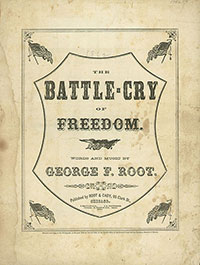
When the Civil War broke out in 1861, composers of popular song were quick to write music that reflected the current political situation. Civil War songs typically came in two varieties: patriotic songs, and songs for those left behind. Patriotic songsRousing, upbeat, and optimistic songs on political subjects and supporting one’s own country. were rousing, upbeat, and optimistic, meant to encourage and invigorate listeners. They promoted nationalistic causes. George F. Root’s "Battle Cry of Freedom ♫" was a recruiting song for the Union Army and focused on imagery such as the flag, cheering, and fighting for one’s ideal, and it included a rousing chorus that exclaimed, "The Union forever! Hurrah, boys, hurrah!" The Confederacy also had patriotic songs.
Dan Emmett’s "Dixie ♫" (1859) was widely adopted in the South and served as an unofficial anthem during the war, proclaiming, "I wish I was in Dixie, hooray! Hooray!" during its choruses. Other songs such as Walter Kittredge’s "Tenting on the Old Campground ♫," Julia Ward Howe’s "Battle Hymn of the Republic ♫," and James Ryder Randall’s "Maryland, My Maryland ♫" also followed these models of patriotic songs during the period.
During the Civil War, other parlor songs were written for the women who had been left behind during the war. Composers and sheet music publishers released dozens of sentimental songs with titles such as "The Vacant Chair ♫" and "Just Before the Battle, Mother ♫," which targeted the sisters, mothers, and wives of men who were fighting in the war. Henry Tucker’s "Weeping, Sad, and Lonely ♫" tells the tale of a young woman whose fiancé has gone away to war. The verses are sung by a solo voice, and an SATB chorus joins her during the chorus, as if to suggest the support of an entire family or community. While the men were away "tenting on the old campground" or shouting "the battle cry of freedom," the women who were still at home continued to make music in their absence.



