
Overview
Objectives
- Examine the roots of soul music and the cultural and economic factors that led to its creation
- Identify several prominent artists from the genre of soul music including Sam Cooke, the Supremes, the Temptations, and Aretha Franklin
- Identify several record labels that were critical to the development of soul music, including Motown, Atlantic, and Stax
Motown
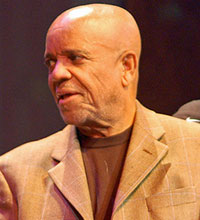
Some of the earliest soul music happened in Detroit in December of 1960 with the release of "(My Mama Told Me You’d Better Shop Around ♫)," words and music by William "Smokey" Robinson and Berry Gordy, Jr. In the early months of 1961, it was in the Top Ten charts. It was a strong opening for a brand new musical group and a brand new record company, Motown.
In 1959—the same year that Don Kirshner started Aldon Music and established the Brill Building style— Berry Gordy, Jr. borrowed eight hundred dollars from his family, and he rented an eight-room house at 2648 West Grand Boulevard.
Gordy first called his new company Hitsville U.S.A., and then he changed the name to Motowna Detroit-based recording company founded by Berry Gordy, Jr. that produced hits by African American performers in recognition of Detroit’s fame as the Motor City. Motown was one of the largest and most successful businesses owned and operated by African Americans. Gordy was a devotee of Booker T. Washington’s philosophy of economic betterment, and he built Motown as an African American enterprise that focused on community and self-reliance.
Through the period of racial unrest and riots in the 1960s, Motown artists sang of love and other human concerns with which people of all races, religions, and political beliefs could identify. Gordy cultivated in his performers a sophisticated image, and many black Americans saw the Motown performers as role models. In his seventh year of business (1967), Gordy sold more singles than any other record company in the world, independent or major, and his empire was profiled in Fortune, the New York Times, and several other major publications. It is estimated that an astronomical 75% of all Motown releases ended up somewhere in the Top 40, a number to which other record companies could aspire but could never achieve.
Gordy mixed the elements of previous African American and pop music styles to arrive at a product that would appeal to the market—classic saxophone-driven big band riffs, gospel tambourines, hand-clapping backbeats, lush orchestra strings from the Detroit Symphony for the slow tunes, and strong bass lines laid down below Latin- and jazz-tinged rhythm patterns. He avoided suggestive lyrics or gritty sounds for two reasons. One, he wanted to appeal to white teenage listeners. Two, he wanted to prevent white artists from covering his songs, and if the version by a black artist was palatable to whites, then there would be no need for white cover versions.
Gordy not only oversaw the music of Motown, but he also cultivated specific looks and images for his performers. He wanted to create a carefully-crafted image of middle class African Americans to present to the rest of the country. Gordy hired modeling school director Maxine Powell, who taught the young performers how to make small talk at cocktail parties, how to hold their silverware at a banquet, how to move and act with the grace and style, and how to dress. The performers called Powell’s training "the charm school." Gordy wanted his performers to be prepared to enter the highest realms of society and to behave gracefully. Powell often told her students that she was training them to appear at Buckingham Palace and at the White House. Gordy also hired Cholly Atkins, a dancer and choreographer in the legendary 1930s Cotton Club revues, and Maurice King, the music director for big name jazz acts at Detroit’s famous Flame Show Bar. Atkins and King would not let the musicians perform until they had learned their stage lessons. Motown artists were classy, elegant, impeccably dressed, and perfectly mannered, all of which were carefully manipulated by Gordy and his team.



"Sam Cooke was one of many R&B acts to tour extensively on the "chitlin' circuit," the name given to segregated clubs and venues that were friendly to African-American musicians during the segregated years of the 1950s-1960s. "
