
Overview
In the 1950s, disc jockey Alan Freed was an important figure in the promotion of African American popular music, and he began calling it “rock and roll.” Soon, white artists such as Bill Haley and His Comets and Pat Boone began recording cover versions of black artists’ songs, most of which were more commercially successful than their black counterparts. The most successful of all the early rock and rollers, of course, was Elvis Presley. Presley’s ascent to stardom in the 1950s secured the popularity and commercial viability of the genre of rock and roll.
Objectives
- Recall the technological changes and its impact in the music industry
- Examine the influence of disc jockey Alan Freed
- Identify various rhythm and blues artists
- Examine some of the ways that white artists modified the music of black artists in their cover versions
- Recall the music that Elvis Presley recorded during the 1950s
Elvis’s Cover Versions
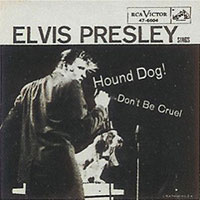
Elvis Presley was a singer, not a songwriter. He never wrote any original material. Although he could play the guitar reasonably well, he did not know how to read or write music, and he learned all of his material by rote. As a result, all of his songs were either the products of cover versions or of songwriting teams, or sometimes both, as was the case of "Hound Dog ♫." Written by the songwriting duo of Jerry Leiber and Mike Stoller, "Hound Dog ♫" was first recorded by the rhythm and blues artist Big Mama Thornton in 1953. Big Mama Thornton’s version of the song is raw, gritty, and far more suggestive than Presley’s cover.
While Big Mama Thornton’s lyrics have a clearly sexual undertone, the lyrics of Presley’s cover version become almost nonsensical. As we saw in the previous lesson, white rock and roll covers of black artists’ rhythm and blues songs frequently edited the lyrics almost to the point of incomprehensibility in order to negate any possible references to sex or sexuality. "Hound Dog ♫" was a runaway success for Presley, spending eleven weeks at number one on the pop charts in 1956.



