
Overview
Elvis Presley’s early recordings for Sun Records were in a musical style that was called rockabilly, which was a mixture of rhythm and blues, country and western, honky tonk, boogie woogie, and gospel music. When Elvis made the move to RCA, other recording artists continued making records in this rockabilly style. Artists such as Buddy Holly, Johnny Cash, Carl Perkins, and Eddie Cochran all made names for themselves as rockabilly artists.
Objectives
- Examine the defining musical characteristics of rockabilly and consider how artists combined different genres of music to create a new style
- Examine the shift in rock and roll that occurred at the end of the 1950s, often marked by “The Day the Music Died”
- Identify various rockabilly music artists and defining characteristics of their musical styles
Johnny Cash
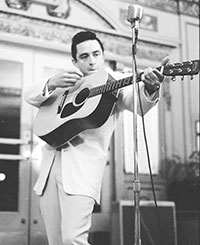
Johnny Cash’s ascent at Sun Records coincided with Elvis Presley’s move to RCA and the mainstream. Cash’s first single, "Folsom Prison Blues ♫" (1956) appeared on the country and western charts, but it did not cross over to either the pop or rhythm and blues charts. "I Walk the Line ♫," released at the end of 1956, did chart on both the pop and country and western charts. It was the first of the four Top 40 pop singles that Cash would record at Sun Records, including "There You Go ♫," "Ballad of a Teenage Queen ♫," and "Guess Things Happen That Way ♫." Following Elvis’s lead, Cash left Sun Records at in 1957, signing with the major label Columbia. He went on to record a number of gold and platinum albums and to host his own television show.
Cash’s musical style was decidedly more country and western than it was rhythm and blues, although he is certainly a member of the rockabilly tradition. According to legend, when Cash first went to Sun Records and auditioned for Sam Phillips by singing gospel songs, Phillips told Cash that he was no longer a gospel singer, advising the young Cash to "go home and sin, and then come back with a song I can sell." The transition to the hard-edged country and western style proved lucrative for Cash. Cash performed on stage dressed in black clothing, which resulted in his nickname, "The Man in Black." He stuck to a simple formula for his live concerts, announcing, "Hello, I’m Johnny Cash" and then launching into a performance of his signature "Folsom Prison Blues ♫."



