
Overview
As we saw in the last lesson, the 1960s saw an increase in the control of record companies and a decrease in the power of musicians and disc jockeys. In this lesson, we will consider some other styles of music that were popular during the early 1960s and how those genres of music related to the changes in the music industry that we saw in the previous lesson. The record producer became an increasingly important part of the recording process, often considered more important to the final product than the singer. On the West Coast, the genre of surf rock emerged, capturing the hearts and minds of American teenagers.
Objectives
- Examine how and why the producer was such a critical part of the recording process, focusing specifically on Phil Spector and how he created his wall of sound
- Recognize the stylistic characteristics of surf rock
- Examine the different influences that contributed to surf rock
Surf Rock

In our study of music from the late 1950s and early 1960s, we have seen several styles that promoted the interests of record labels, producers, and television show hosts over the artistic vision of the musicians. Teen idol pop, girl groupssinging groups in the early 1960s made up mostly of African American teenage girls, and records produced by Phil Spector dominated the charts in the early 1960s. Now, we turn to another style of music that was popular at the time, a style that blended the sounds of doo-wop, Chuck Berry’s style of rock and roll, Phil Spector’s production style, and the wholesomeness of teen idols: surf rocka style that blended the sounds of doo-wop, Chuck Berry’s rock and roll, Phil Spector’s production style, and the wholesomeness of teen idols and dealt with light, fun topics such as surfing, girls, and hot rod cars.
Surf rock dealt with light, fun topics such as surfing, girls, and hot rod cars. About the same time "The Twist ♫" captured the East Coast on American Bandstand, a different style of music grew up on the beaches in southern California with Dick Dale and the Del-Tones, the Chantays, the Surfaris, Jan and Dean, the Marketts, the Surfriders, the Belairs, the Surf Teens, the Beach Boys, and the Astronauts (who were actually from Colorado). Dick Dale became a West Coast legend when he combined his love of surfing and playing guitar. Dale claimed that he wanted to combine the feelings of power that he had when he was playing his guitar and when he was surfing and then project those feelings of power through his music. As a result, he recorded songs with sharp, short guitar chords with generous amounts of of reverb. His guitar playing also included rapid, double-stroke picking and frequent uses of slides on the neck, which can be heard in his most famous single, "Miserlou ♫" (1962). Dale signed with Capitol Records in 1963, and aspiring musicians clamored to imitate his style of surf guitar.
One musician who borrowed some of Dale’s guitar techniques was Duane Eddy. Eddy played near the bridge of the guitar to make the sound even more brittle and metallic. Eddy’s music had a similar kind of raw energy compared to Dale’s, but it was often more commercial-sounding. Recording most of his material at Audio Recorders in Phoenix, Arizona, Eddy often sent the master tape to Gold Star Studios in Hollywood to have a saxophone track added. Soon, Duane Eddy and the Rebels attracted a cult following in the United States and the United Kingdom with songs such as "Rebel Rouser."
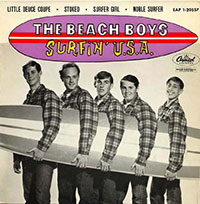
The most famous and successful of all the surf rock groups from the 1960s, however, was the Beach Boys. Brothers Brian, Carl, and Dennis Wilson joined with their cousin, Mike Love, and a neighbor, Alan Jardine, in Hawthorne, California, for what became a long, occasionally irregular, but successful career. The group first called themselves The Pendletones, a musical play on "Pendleton," which was a plaid flannel shirt popular among surfers. They were Kenny and the Cadets for their first recording. There was no one in the group named Kenny, but their first tune was "Barbie" (1961) when the Ken and Barbie dolls were first becoming popular. The Beach Boys signed with Capitol Records in 1962, and by the end of the 1960s, they had released 26 Top 40 hits. Even as the Beatles began their invasion in 1964, the Beach Boys held their own, charting their first number 1 hit with "I Get Around ♫."
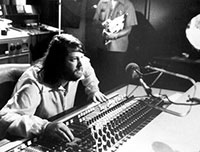
Brian Wilson was the musical leader of the group, and he made almost all of the important decisions on every aspect of the songwriting and recording processes. Wilson wrote appealing lyrics about surfing, hot rods, and California girls and then sang those tunes in a four-part harmony style like the Four Freshman, the Hi-Los, and other male vocal harmony groups of the 1950s. Finally he added Dick Dale’s surf guitar sound but greatly toned down the volume and complexity. The Beach Boys’ musical tales of romance, surf, and sun quickly caught on with American teenagers.
Chuck Berry’s music was so influential on Wilson and the Beach Boys that one of their greatest hits, "Surfin' U.S.A. ♫" (1963), was actually a reworking of Berry’s "Sweet Little Sixteen ♫" (1958). However, Wilson gave no credit to Berry, and a long legal battle developed when Berry sued the members of the Beach Boys for copyright infringement. Now, Berry is listed as co-author of "Surfin' U.S.A. ♫" "Surfin' U.S.A. ♫" includes a list of all the surfing hot spots in southern California and claims, "Everybody’s gone surfing." The electric guitar style features heavy reverb and is very reminiscent of Chuck Berry guitar solos from the 1950s.
Wilson respected and admired Phil Spector’s style of production and wanted to emulate it; in fact, Wilson was driving the first time he heard "Be My Baby ♫," and he claimed that he had to pull off the road in order to avoid causing an accident. He originally wrote "Don't Worry Baby ♫" for Spector to produce and for the Ronettes to record, but Spector rejected Wilson’s demo. Wilson and the Beach Boys then recorded the track, which ended up as the B side to "I Get Around ♫," their first number 1 record.
Wilson and the Beach Boys wrote and recorded most of their songs in the style of surf rock until 1964. After that point, Wilson began to experiment with a variety of recording technologies, new instruments, and sound effects, many of which were a part of the growing interest in psychedelia and the psychedelic music movement. We will return to the Beach Boys and their music from the latter part of the 1960s in a subsequent lesson.



