
Overview
In this lesson, we will see the tremendous influence that British musicians exerted on American popular music during the 1960s. The sudden popularity of British rock bands in the United States is called the British Invasion. After the Beatles appeared on The Ed Sullivan Show in February 1964, the British presence in rock and roll was firmly established.
Objectives
- Recall the development of rock and roll in Britain, focusing specifically on origins and early careers of the Beatles and the Rolling Stones
- Recall the number of stylistic, personnel, and managements changes of the Beatles before settling into the image of the Fab Four in matching suits
Becoming the Beatles
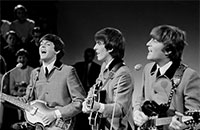
The first iteration of the Beatles formed in 1957. John Lennon and Paul McCartney teamed up as a band called the Quarrymen, named after John’s Quarry Bank High School. The band went through various lineups and name changes in the late 1950s, including the names such as the Rainbows, the Moonshiners, the Nurk Twins, and Johnny and the Moondogs. Then another guitarist, Paul’s friend George Harrison, joined the group. The members of the band were listening to American rock and roll and emulating their favorite groups.
The very first recording that the Beatles ever made (although they were recording as the Quarrymen at the time) was a 1957 cover of Buddy Holly and the Crickets’ "That'll Be the Day ♫." The same record includes an original tune called "In Spite of All the Danger ♫," which Harrison and McCartney wrote in close imitation of Holly’s style.
Stu Sutcliffe bought a bass and joined up, and then the group added Pete Best on drums. The Silver Beetles now had three guitarists, a bass, and a drummer, and they had an insect band name in honor of Buddy Holly and the Crickets. Lennon, McCartney, and Harrison all played guitar and sang in this iteration of the band. Their first manager, Liverpool club owner Allan Williams, changed the "e" to an "a" in their name and got them a two-month engagement at the Indra in Hamburg, Germany. At the same time, they were regulars at the Cavern Club in Liverpool.
Stu Sutcliffe left the group, so McCartney became the bassist. In 1961, Brian Epstein was working in his father’s record shop and had several requests for Beatles recordings. He was unable to locate a single recording by the Beatles. Since the Cavern Club was only a few blocks from his record store, he went to hear the band perform. After a few informal meetings, Epstein became the band’s manager. He put them in matching suits and ties, and he insisted on their matching haircuts. He also encouraged them to polish and solidify their playlists, which also lent their performances in increased sense of professionalism. Pete Best said, "He forced us to work out a proper program for the evening, playing our best numbers, not just the ones we felt like playing at the moment."
When Decca Records rejected his group, Epstein went to his friend George Martin, who was a recording engineer with the EMI label. "Love Me Do ♫" and its B side, "P.S. I Love You ♫," succeeded modestly in the UK, reaching No. 17 on the British pop charts. Encouraged, Epstein and Martin set up another recording session for November of 1962. For the November session, Martin insisted that Pete Best be replaced. Richard Starkey was hired and became the Beatles’ permanent drummer. The six magic components of an unparalleled musical team were now in place: John, Paul, George, Ringo, Brian Epstein, and George Martin.



