
Overview
In an earlier lesson, we encountered a number of subgenres of country and western music that became popular during the 1940s, such as the country crooner and honky-tonk. In this lesson, we will focus specifically on the genre of bluegrass. Bluegrass music had had devoted followers since its earliest days, but during the 1960s, more and more people came to listen to and appreciate the music. The folk revival movement, coupled with mainstream exposure in Hollywood films, introduced a new generation of listeners to bluegrass.
Objectives
- Identify three key figures of bluegrass: Bill Monroe, Earl Scruggs, and Lester Flatt
- Examine the three musicians and the key characteristics of bluegrass music, such as instrumental techniques, instrumental combinations, and the connections between bluegrass music and earlier types of hillbilly music such as the string band
Bill Monroe and the Birth of Bluegrass
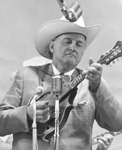
In addition, Monroe frequently accompanied his fiddler uncle on the guitar at local country dances. Monroe also loved listening to the recordings of Jimmie Rodgers and other early hillbilly musicians. He received equal training and exposure in religious music, the blues, and hillbilly music, which helps to account for his unique approach to performance.
At the age of eighteen, he joined his older brothers Birch and Charlie in an oil refinery in East Chicago, Indiana. At night, they played for dances and parties in the area. Although Monroe had grown up playing the guitar, he switched to the mandolin when he and his brothers formed their band because Birch played the fiddle and Charlie played the guitar. They were soon hired as regulars on WLS, the Chicago radio station. Brother Birch soon left the group, but Charlie and Bill continued to have a successful career as the Monroe Brothers. As a duo, they were signed by RCA Victor in 1936, and they recorded 60 tracks between 1936 and 1938.

Charlie and Bill Monroe worked together as the Monroe Brothers until they dissolved the partnership in 1938. Bill then organized his Blue Grass Boys, recruiting singer and guitarist Cleo Davis, fiddler Art Wooten, and bassist Amos Garren. In 1939, Bill Monroe and the Blue Grass Boys successfully auditioned for a regular spot on the Grand Ole Opry. His big hit from this period was "New Mule Skinner Blues ♫," a cover of a Jimmie Rodgers song. The music that Monroe performed in the late 1930s and early 1940s is representative of Monroe’s gradual transition from the string band tradition into the new genre of music that would be named after his band.
During this period, Monroe experimented with different instruments and performers. For a while, Sally Ann Forester played accordion, but the instrument was soon dropped from the band. Further, Monroe rarely sang lead during this time. Instead, he preferred to sing harmony in his high tenor voice. The music recorded during this period is a mixture of religious songs, folk music, covers of hillbilly music, instrumental numbers, and a few original compositions. The group was gaining acclaim for its remarkable fiddlers, and the "chopping" rhythm of Monroe’s mandolin player set his band’s sound apart from those of other string bands at the time. Yet, they were still missing a crucial component: a banjo. Monroe rectified this by adding David "Stringbean" Ackerman in the early 1940s. Ackerman only lasted a few years, and in 1945, he was replaced with Earl Scruggs.



