
Overview
Objectives
- Recall the significance of the San Francisco scene and the Kesey acid tests in order to understand why the Bay Area became home to the burgeoning psychedelic music movement
- Examine the eclectic musical style of the Grateful Dead, who are generally regarded as the most important Bay Area band from this period
- Examine the music of Donovan, whose gentle, folk-inspired delivery and utopian worldview spoke to many members of the countercultural movement
- Examine the music of the Doors, who represented the darker side of psychedelic music
Utopian Psychedelia
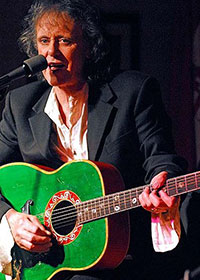
As mentioned in the previous lesson, the United Kingdom also had an active underground countercultural and psychedelic music scene. In the mid-1960s, Scottish folk singer and songwriter Donovan traveled in many of the same circles as Bob Dylan. He also idolized the music and politics of Woody Guthrie, and early singles such as "Catch the Wind ♫" are typical of his folk style from this period. The song is a strophic ballad, and the title line recurs at the end of each verse, serving as a refrain. Donovan accompanies himself on acoustic guitar and harmonica. As folk rock increased in popularity, Donovan began incorporating stylistic elements of it into his music. Songs such as "Sunshine Superman ♫" and "Mellow Yellow ♫" include electric guitars, electric keyboards, electric bass, and drums. "Sunshine Superman ♫" blends folk, psychedelia, and Donovan’s own brand of optimism.
In addition, several of the instrumentalists featured in this song already had illustrious careers or would soon become major figures in rock music. Jimmy Page (of the Yardbirds, the New Yardbirds, and Led Zeppelin) is the guitarist, John Paul Jones (of Led Zeppelin) is the bassist, and John Cameron (songwriter and composer) played keyboards and arranged the song. Donovan’s folk background is evident because the song is strophic, and the title line recurs at the end of each verse as a refrain. The psychedelic aspects of "Sunshine Superman ♫" come from the unusual instrumental sounds and mystical lyrics, such as "I’ll pick up your hand and slowly blow your little mind" and "could have tripped out easy, but I’ve changed my ways."
Donovan’s understated vocal delivery style and positive, dream-like lyrics made him a favorite of the pacifist side of the late 1960s countercultural movement. In "Hurdy Gurdy Man ♫," for example, Donovan describes being visited by the Hurdy Gurdy Man and the Roly Poly Man, both of whom sing songs of love. In the song, Donavan plays a tamboura that was a gift from George Harrison. The song "Atlantis ♫" tells the story of the lost city of Atlantis and suggests that the city could be a model for rebuilding Western society. These and other Donovan songs presented a sense of cultural utopia and peace that many members of the counterculture were desperately seeking to attain.



"During the Summer of Love, the uptight but curious could take an antiseptic tour of Haight-Ashbury from inside a Gray Line bus. It was called the "Hippie Hop." Flower children reacted by holding up mirrors at the gawkers. But eventually, the use of methamphetamines and other drugs fueled a crime wave and ugly street scenes. As the summer faded, many of the hippie elite picked up and moved across the Golden Gate Bridge to Marin County."
