
Overview
The mid-1960s were a time of upheaval for young people in the United States. The Civil Rights Movement, protests against the Vietnam War, and the movement for women’s rights inspired many people to become suspicious of the American institutions that they were supposed to trust. This distrust and sense of separation led to the development of a countercultural movement that was passionate about maintaining its distance from the mainstream. In particular, many young people sought a new vantage point from which to view the world. In response, musicians began recording psychedelic rock, which was also intended to change the listener’s consciousness or point of view.
Objectives
- Examine how and why psychedelic music became popular in the mid-1960s
- Recall how the Beach Boys changed their earlier styles of music and began recording psychedelic rock
- Recall how guitarists such as Jimi Hendrix experimented with distortion and feedback to create new sounds on the electric guitar
- Recall how new recording techniques, instruments, technologies, and lyric sources all guided these musicians as they began explore different modes of expression and realms of consciousness in their music
- Examine the Woodstock Music and Art Festival of 1969, regarded as the pinnacle of the music and culture of the late 1960s
The Ambitious Single continued
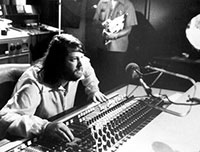
The form of "Good Vibrations ♫" is particularly unusual because it is in four related but distinct parts. In fact, each of these four parts were recorded separately and then spliced together. (If you listen closely, you can hear the abrupt splices at 1:41, 2:13, and 2:58 in the recording.) The song starts in verse-chorus form, with two verses and two choruses. After the second chorus, however, a completely new section begins, which is then followed by two other new sections of music. This innovative approach to form is another characteristic of psychedelic music of the late 1960s. Instead of writing music to fill up preconceived forms such as verse-chorus, songwriters let their ideas dictate the form that the song would take.
"Good Vibrations ♫" is filled with unusual instruments and surprising sounds. By sticking thumbtacks into the hammers of a piano, the sound is dampened and completely different from that of a regular piano. Wilson also included a Jew's harp, which is an instrument that is held against the mouth and then plucked with the fingers. Other instruments such as sleigh bells, maracas, cellos, bass harmonica, and both high and low organs appear in "Good Vibrations ♫." Perhaps the most iconic sound in this song comes from the Thereminan electronic instrument that has two antennas that allow the performer to change the pitch and volume simply by moving their hands between the antennas; it was used on the Beach Boys song “Good Vibrations. The Theremin has two metal antennas that sense the location of the player's hands. One antenna controls for frequency, and the other controls for volume. Until "Good Vibrations ♫," the Theremin was primarily used to create the eerie sounds that were heard in science fiction movies of the 1950s.
With "Good Vibrations ♫," we can see how songwriters and musicians in the 1960s became increasingly ambitious in the production of their singles. They no longer felt constrained to a certain instrumentation, topic, form, length, or production style. Instead, their message and their art dictated the sounds of their music.



