
Overview
The publishing district of Tin Pan Alley was the leading producer of popular music in the United States at the turn of the twentieth century. A sheet music publishing district in New York, Tin Pan Alley produced sheet music at higher rates and employed more aggressive sales techniques than publishers in the nineteenth century had used. Tin Pan Alley songs had several specific features and styles, all of which will be addressed in this lesson. A popular genre of instrumental music called ragtime also influenced the composition of Tin Pan Alley songs.
Objectives
- Examine the aspects that made Tin Pan Alley songs successful, such as specific forms, sentimental lyrics, and inexpensive sheet music
- Examine how Tin Pan Alley rose in popularity at the turn of the twentieth century
- Identify Tin Pan Alley composers
- Define vaudeville
- Define ragtime
- Identify the features of ragtime music
The Music of Tin Pan Alley
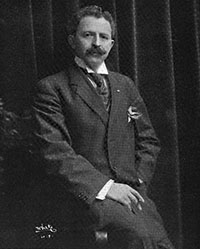
Harry von Tilzer, also known as the "Daddy of Popular Song," often told other composers and songwriters to keep their melodies simple, so simple, in fact that even the smallest child would be able to hum the tune. His songs, such as "A Bird in a Gilded Cage ♫" and "I Want a Girl Just Like the Girl That Married Dear Old Dad ♫," exemplify this melodic simplicity.
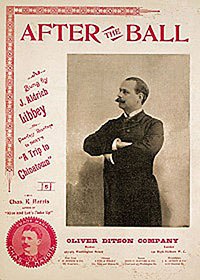
The first major hit from Tin Pan Alley was "After the Ball ♫" (1891), composed by Charles K. Harris. "After the Ball ♫" exemplifies many aspects of the Tin Pan Alley song of the time. It was a lengthy ballad on the topic of lost love. At the song’s beginning, a child asks an old man why he never married. Throughout the song, he explains that he once had a sweetheart, but a tragic misunderstanding led them to separate.
He saw her talking with and kissing another young man, and he left her. Heartbroken, he never loved again, and years later, he learned that the other young man was actually his sweetheart’s brother. "After the Ball ♫" is in verse-chorus form, which remained the preferred form for popular songs well into the twentieth century. Like many successful Tin Pan Alley songs, "After the Ball ♫" is a waltz—a dance in a triple meter. A song in triple meter has three beats per measure, with emphasis on the first beat. (Think of a waltz as "oom-pah-pah," "oom-pah-pah.")
True to the Tin Pan Alley marketing strategies, Harris knew he had a hit on his hands and paid a popular vaudeville singer J. Aldirch Libbey to perform the song during all of his performances. He paid Libbey $500 and offered him a share of the song’s profits, thereby ensuring that "After the Ball ♫" would be sung in every performance. The song was an instant hit—audiences frequently asked the performer to repeat it three, four, or five times during each performance. "After the Ball ♫" became a smash hit for sheet market sales, selling over five million copies of sheet music during the 1890s. Harris’s simple, catchy, sentimental song and his marketing strategy created the model for Tin Pan Alley composers of the next decades to follow. Harris had actually published the song himself because he did not think the royalty payments from any of the publishers to whom he had offered the song were generous enough. This turned out to be a lucrative business move. During the 1890s, Harris was earning at least $25,000 a month from sales of the song, which afforded him the opportunity to open his own song publishing business in New York in 1903.

"Before the turn of the century, only three American composers made an appreciable dent in the German consciousness: John Philip Sousa, James A. Bland, and Stephen Foster"


