
Overview
This lesson addresses two separate but related genres of rock. Country rock is a hybrid of country music and rock music, while Southern rock incorporates themes from the American South into music that is otherwise relatively standard rock in its sound and instrumentation. There are many different sounds and artists that have been classified as country rock, and many of these sound very different from each other.
Objectives
- Identify the defining stylistic characteristics of country rock
- Identify the defining stylistic characteristics of Southern rock
- Recall the instrumentation, musical influences and backgrounds, and lyric themes of several country rock and Southern rock artists
Southern Rock
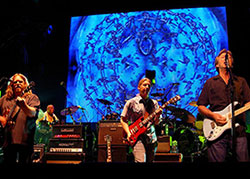
Southern rock is a genre of music that is associated with themes and values from the American South. Unlike country rock, which infuses rock music with instrumentation and ideas borrowed from country music, Southern rock typically sounds like other types of rock music. Southern rock artists portrayed themselves in their music as independent, highly masculine, and outlaw figures.
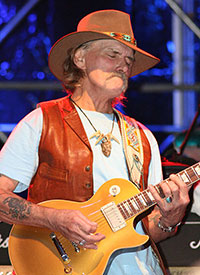
One of the earliest and most successful Southern rock bands was the Allman Brothers Band. Their music combined elements of soul, rhythm and blues, rock, jazz, blues, and country music. The instrumentation of the Allman Brothers Band was notable for several reasons. First, they had two lead guitars instead of just one. Both Duane Allman and Richard Betts served as lead guitarists for the group, and they played at the same time; occasionally, they doubled each other or played the same part an octave apart, and other times, they played two different ideas simultaneously. They would also improvise new melodies at the same time, trading off every two measures in a technique that is called trading twoswhen two lead guitarists improvise new melodies at the same time, trading off every two measures. Second, the group had two drummers, Jaimoe Johanny Johanson and Butch Tracks. By doubling the number of guitarists and drummers, the Allman Brothers Band had a much thicker, fuller sound compared to other rock bands of the period. The group also included bassist Barry Oakley and keyboardist Greg Allman, who was Duane's brother and thus the inspiration for the band's name. Many members of the group had strong backgrounds in the blues, and this influence was evident in the prominent role that instrumental solos played both in their recordings and in their live performances. It is also worth noting that Johanson was the only black member of the band, but it was still quite unusual at the time for rock bands to include members who were not white.
One measure (bar) of 12/8: 1 - and - uh - 2 - and - uh - 3 and - uh - 4 - and - uh
Then, 11/8 is simply a truncation of the final "uh" from beat 4 in a 12/8 measure, which creates an asymmetrical meter and a feeling of instability because the expected placement of beats has been disrupted. This use of complex and asymmetrical meters reveals the band's interest in modern jazz, which also experimented with unusual arrangement of the rhythms.
The Allman Brothers Band was just beginning to find success when Duane Allman was killed in a motorcycle accident in 1971. Their first recordings after Allman's death simply included one lead guitar, but eventually, Greg Allman hired a keyboard player to replace himself and switched to lead guitar in order to replicate the sound the band had had before his brother's death. With this lineup, the Allman Brothers Band had their only single to reach the Top Ten, 1973's "Ramblin' Man ♫." The group broke up in 1976, but several members went on to create new bands or record solo projects.



