
Overview
The 1960s were a period of protest and upheaval in American race relations. The Civil Rights Act had passed in 1964, and it outlawed segregation and prohibited discrimination. The Voting Rights Act of 1965 prohibited discrimination in voting practices. Martin Luther King, Jr. promoted a message of peace and solidarity, encouraging civil disobedience and peaceful protests for African Americans to ensure that they were treated equally in all areas of society. Musicians such as Sam Cooke, Curtis Mayfield, and James Brown sang about black pride and black empowerment. James Brown became one of the most important voices of black pride, earning the nickname “Soul Brother Number One.”
Objectives
- Recall the relationship between music and the American civil rights movement during the 1960s
- Recall how artists such as Curtis Mayfield and Sam Cooke advocated for civil rights in their music
- Examine the role James Brown played in the musical messages of the civil rights movement and the Black Power movement
- Identify characteristics of Brown’s musical style from this period
- Recall several other musicians who conveyed meaningful musical messages to African American audiences during the 1960s and early 1970s, such as Stevie Wonder and Sly and the Family Stone
James Brown continued
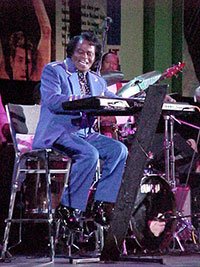
The lyrics of Brown's music were inspiring, but his message was amplified through his performance style. Like Aretha Franklin, Brown grew up in the church and was as familiar with gospel music as he was with rhythm and blues, soul, and rock and roll. During his songs, Brown would grunt, shout, scream, and wail, all of which were rhetorical gestures of gospel music and gospel preaching styles. Like a gospel preacher, during his live shows, Brown would build to a fever pitch toward the end of his show. He would collapse to the stage, ostensibly from exhaustion, and he would be covered with a cape and led off the stage. Brown, much to the audience's delight, would throw off the cape and return to finish the number and the show.
The significance of James Brown's role in the civil rights movement cannot be understated. He was frequently referred to as "Soul Brother Number One," which suggested not only the quality of music but also his ability to speak to and on behalf of many members of the African American community. Brown has even been credited with saving the city of Boston from riots and destruction following the assassination of Martin Luther King, Jr. King was murdered on April 4, 1968, and Brown was supposed to perform at Boston Garden the following night. After King's assassination, major cities such as Chicago, Detroit, and Washington, D.C. were experiencing riots and violence. Boston mayor Kevin White considered canceling Brown's concert for fear of inciting riots in the city, but instead, White and his advisors chose to allow the concert to continue. In addition, they made last-minute arrangements to have the concert televised in hopes that Brown's appearance would encourage people to stay home, watch, and listen rather than taking to the streets. Most critics agree that Brown gave the performance of a lifetime, and he is often praised for keeping the peace in the city of Boston during one of the darkest hours in American history.
Although Brown was an important spokesperson for the Black Power movement, not all of his music was about black empowerment. Songs such as "Papa's Got a Brand New Bag ♫" (1965) is about a man who has mastered every dance craze, such as the Mashed Potato, the Jerk, and the Fly. "Cold Sweat ♫" (1967) is an ode to the cold sweat that is brought on by a woman's appearance. Brown was able to balance his messages between those of those of "Get Up (I Feel Like Being a Sex Machine) ♫" and "Get Up, Get Into It, Get Involved ♫," both of which were released in 1970.



