
Overview
Objectives
- Recall the key tenets of progressive rock, such as classically-inspired instrumentation, instrumental virtuosity, and albums that focused on a single, central theme
- Examine the significance of Genesis, Pink Floyd, and Frank Zappa within the prog rock movement
- Recall how each of these group artists or groups created a unique interpretation of progressive rock
Genesis continued
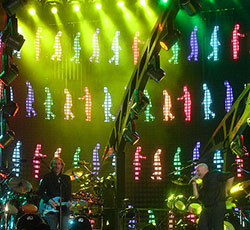
In 1974, Genesis released The Lamb Lies Down on Broadway, which was a double disc concept album that is over an hour and a half long. The album tells a surreal story of a young Puerto Rican boy named Rael who must battle monsters and nightmares to rescue his brother from danger. The live performances of The Lamb Lies Down on Broadway were the apex of Genesis’s and Gabriel’s theatricality. During his performance of the first half of the show, Gabriel dressed as Rael, wearing a leather jacket and jeans. He did not have props or other costumes and instead relied on lights and his own expression to tell the story.
During the second half, however, Gabriel pulled out all the stops. Elaborate costumes, visual effects, and lighting were a critical part of the performance. Gabriel dressed as the Slipperman, a naked, grotesque monster covered with bulbous growths who crawled out of a tube shaped like a giant phallus. During "it," which was the final song, Gabriel stood side-by-side with a mannequin that looked exactly like him, challenging the audience to identify the real man.
Gabriel’s performances were electrifying, and Genesis presented a stage show unlike any other band. However, Gabriel’s interest in theatricality posed several difficulties for the band. First, his stage effects were dangerous: during one performance, a special effects explosion went wrong, forcing the band to stop playing. Gabriel’s costumes were sometimes so elaborate that he was unable to place the microphone close enough to his mouth to be heard. Finally, the other members of the band began to resent the attention paid to Gabriel. The other members of Genesis were remarkable musicians as well, but they felt as if they were being overshadowed.
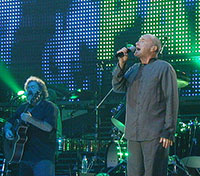
For example, during live performances of The Lamb Lies Down on Broadway, Collins was performing not only with a drum set but also with more percussion instruments than many symphony orchestras had, including timbales, temple blocks, orchestral bells, a vibraphone, tubular bells, and tuned tambourines. Rutherford was playing on a double neck electric guitar , which allowed him to combine and interchange several elements on the same guitar, rather than constantly switching back and forth between different guitars. Hackett was one of the first rock guitarist to employ the tapping a guitar technique where the player taps the string against the fretboard with the fingers rather than picking or plucking the strings method on the electric guitar, in which one hand taps the guitar’s strings against the fingerboard instead of picking or plucking the strings. Despite the musical innovations and virtuosity displayed by other members of Genesis, most critics and fans focused on Gabriel and his showmanship.
Gabriel left Genesis in1975 to embark on a solo career, and Collins moved from drums to lead vocals. At first, the band attempted to replicate Gabriel’s stage performances using Collins, but by the 1980s, Genesis had turned toward an increasingly commercial sound, exemplified in albums such as Invisible Touch (1986) and We Can’t Dance (1991).



"[Genesis'] first album was called From Genesis To Revelation. It sold about 650 copies, partly because record stores thought it was a religious album and placed it accordingly."
