
Overview
As we saw in the previous lesson, James Brown and his band developed an early version of funk music during the late 1960s, and they inspired many funk bands in the late 1960s and the 1970s. Funk music often featured a drum break during the last third of the song, during which the other instruments would drop out in order to allow the drummer to solo for a measure or two. This riff-and-groove structure and the importance of drum breaks were definitive characteristics of most funk music during the late 1960s and 1970s. In this lesson, we will survey several important funk artists from this era.
Objectives
- Identify some of the defining features and characteristics of funk music
- Recall the significance of Sly and the Family Stone in the development of funk music
- Recall the role George Clinton played in funk music during the 1970s with P-funk genre
- Examine how popular media such as Blaxploitation films and television programs helped promote African American music and musicians
Sly and the Family Stone
Sly and the Family Stone was an interracial group from San Francisco whose membership included both women and men. Sly and the Family Stone included multi-instrumentalist Sly Stone, guitarist Fred Stone (Sly's brother), trumpeter Cynthia Robinson, saxophonist Jerry Martini, keyboardist Rose Stone (Sly's sister), bassist Larry Graham, and drummer Gregg Errico. The group also included a trio of backup singers called Little Sister, which included Vet Stone (Sly's sister), Mary McCreary, and Elva Mouton.
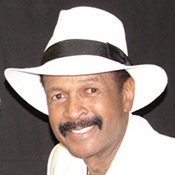
Sly and the Family Stone incorporated many sounds from rock music, such as the fuzzbox, wah-wah guitar pedal, and both vocal and instrumental distortion. Another important feature of Sly and the Family Stone's music was its unprecedented use of the bass. Bassist Larry Graham was an innovative performer, and he transformed the bass from a harmonic instrument to a percussion instrument. Graham would pull, slap, thump, or pluck the bass strings, a technique which can be heard throughout Sly and the Family Stone's "Thank You (Falettinme Be Mice Elf Agin) ♫" from 1969.
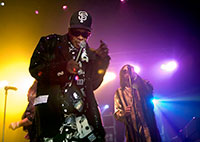
The lyrical messages of Sly and the Family Stone were influenced equally by the civil rights movement and by the countercultural movement. The group's songs frequently speak to peace, love, and equality, all of which were values promoted by the countercultural movement of the late 1960s. The group's first hit was "Everyday People ♫" (1968), which spoke of peace and equality. Written by Sly Stone, "Everyday People ♫" directly addresses issues of equality:
We're all the same, whatever we do
You love me, you hate me
You know me and then
Still can't figure out the bag I'm in
I am everyday people
Each time the title line appears in the song, it is sung by Sly Stone, Rosie Stone, Freddie Stone, and Larry Graham. The group's music frequently alternates between solo and group singing, and the choruses are usually performed by a group of singers.



