
Overview
Objectives
- Recall the key tenets of progressive rock, such as classically-inspired instrumentation, instrumental virtuosity, and albums that focused on a single, central theme
- Examine the significance of Genesis, Pink Floyd, and Frank Zappa within the prog rock movement
- Recall how each of these group artists or groups created a unique interpretation of progressive rock
Pink Floyd
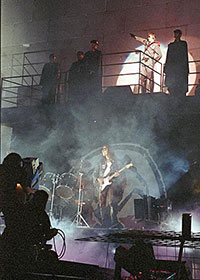
Pink Floyd was a prominent band in the London psychedelic scene of the late 1960s, but by the 1970s, they turned toward an increasingly experimental style. Their lineup in the 1960s included Roger Waters on bass and vocals, Syd Barrett on guitar, Rick Wright on keyboards, and Nick Mason on drums. Barrett, who struggled with drug addiction and mental illness, left the band in the late 1960s and was replaced by David Gilmour. Barrett had written most of Pink Floyd’s lyrics, so when he left the group, Waters took over as composer and lyricist.
Pink Floyd’s albums from the early 1970s were highly experimental; in fact, they typically focused more heavily on electronic sound effects, experimental techniques, and non-traditional sounds than they did on virtuosic instrumental performances.
Albums such as Atom Heart Mother (1970) and Meddle (1971) contain a number of experimental and electronic techniques. In fact, their music from this period was inspired by avant-garde classical composition to the extent that they became the first rock band invited to perform at the Montreaux Classical Music Festival.
Waters was obsessed with madness, paranoia, alienation, depression, and death, and these themes permeate his music. In 1972, he developed a song cycle based on these themes that was called Eclipse. Over time, he expanded and reworked the song cycle, and it became the most successful album that Pink Floyd ever released: The Dark Side of the Moon (1973). The album begins and ends with a heartbeat, and the individual tracks are joined together with the protagonist’s muttering, screaming, and laughing. The single "Money ♫" reflects several aspects Pink Floyd’s approach to prog rock.

The song includes the sounds of cash registers, which are organized rhythmically instead of simply occurring randomly. This use of nontraditional sounds was typical for Pink Floyd. In addition, the meter of this song is 7/4, meaning that each measure (bar) has seven beats instead of four. (It might also be helpful to think as 7/4 as an alternation between one measure of 4/4 and one measure of 3/4.)The result is unsettling because the beats do not fall into neat groupings of four, as was usually heard in rock music. Of course, as we have seen, other groups such as the Allman Brothers Band, Yes, and King Crimson experimented with asymmetrical and unexpected meters. "Money ♫" also includes a bass line that runs throughout the entire song without changing. The lyrics are a commentary on the negative effects money can have on people. The Dark Side of the Moon was one of the most successful albums of all time, spending more than fifteen years on the Billboard charts.



"[Frank Zappa's] album Jazz from Hell was the only instrumental album ever labeled with the PMRC's "Parental Advisory: Explicit Lyrics" label."
