
Overview
Objectives
- Recall the major developments of jazz after swing, including bebop, cool jazz, and fusion
- Recognize Miles Davis and his contribution to the major movements in jazz
- Examine the musical language and controversy of Bitches Brew
- Identify several musicians who formed successful fusion groups during the 1970s and the defining features of their musical styles
Jazz after Swing
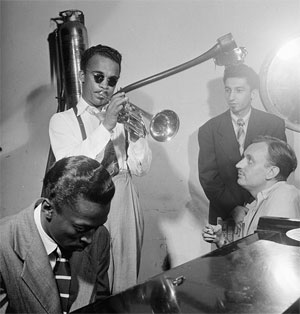
As we saw in early lessons, swing or big band jazz dominated the popular music scene during the 1930s and 1940s. People loved listening to and dancing to these highly organized, meticulously rehearsed ensembles directed by bandleaders such as Duke Ellington and Benny Goodman. For the members of these groups, however, playing the same arrangements night after night became tiresome. Jazz instrumentalists began seeking new ways to express themselves musically.
During the 1940s, jazz musicians began playing in small after-hours clubs in New York.
Instead of playing to please large audiences, the musicians were largely playing for their own edification and enjoyment. Unlike the big bands, these combos were small, often featuring just a piano, bass, and one or two wind instruments. Players such as alto saxophonist Charlie Parker and trumpeter Dizzy Gillespie battled with other musicians on who played the fastest, most complicated, and most creative solos. This style of jazz came to be called bebop style of jazz that emerged in the 1940s that is characterized by fast, complicated solos performed by small combos . Musicians who played in this style were constantly striving to innovate and push musical boundaries.
A style of cool jazz a style of jazz that emerged in response that bebop that emphasized slower, more laid back and intimate performances emerged in response to the blistering tempos and rapid-fire solos of bebop. Cool jazz was slower and more laid back, and it projected a sense of intimacy and closeness that had been absent in bebop. The album that ushered in the era of cool jazz was Birth of the Cool (1957), recorded by Miles Davis and a nonet of both black and white musicians. Davis removed the tenor saxophone in favor of the French horn, and he also eliminated the guitar, and both of these changes lent the ensemble a cooler, more subdued timbre. During the 1950s, Davis focused increasingly on avant-garde styles and expressions, culminating in the album Kind of Blue (1959).
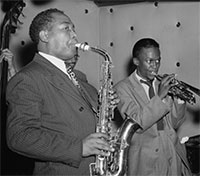
On Kind of Blue, Davis experimented with free forms and unusual harmonies. Davis was always looking for new modes of expression, harmonic languages, interesting rhythms, and innovative instrumentation. His 1970 album Bitches Brew represents yet another phase in Davis’s career: jazz and rock fusion.



"In 2007, Herbie Hancock released his 47th studio album entitled River: The Joni Letters. The album was meant as a tribute and homage to longtime friend and fellow musician Joni Mitchell. Guest vocalists on the album included Leonard Cohen, Tina Turner, Norah Jones, Corinne Bailey Rae, Luciana Souza, and Mitchell herself. In February 2008, the disc beat out Amy Winehouse, Foo Fighters, Vince Gill, and Kanye West to win the Album of the Year award at the 50th annual Grammy Awards in Los Angeles. It was the first jazz album to win the award in over four decades and only the second in the award's history."
