
Overview
Objectives
- Recall the major developments of jazz after swing, including bebop, cool jazz, and fusion
- Recognize Miles Davis and his contribution to the major movements in jazz
- Examine the musical language and controversy of Bitches Brew
- Identify several musicians who formed successful fusion groups during the 1970s and the defining features of their musical styles
Bitches Brew
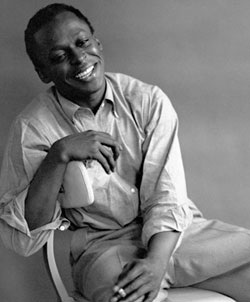
Davis admired the lengthy instrumental solos that he heard rock performers such as Eric Clapton and Jimi Hendrix deliver. Further, Davis became interested in playing for audiences that were of comparable size to rock shows; jazz had never drawn the types of crowds who came to listen to Hendrix. As a result, Davis began experimenting with integrating elements of rock into jazz. For his first recorded foray into fusion, Davis was joined by John McLaughlin on guitar, Wayne Shorter on saxophone, and Joe Zawinul, Chick Corea, and Herbie Hancock on keyboards.
As we will see, all of these musicians went on to create their own jazz fusion ensembles later in the 1970s. The other musicians who played on Bitches Brew were black, white, Latino, American, British, and Austrian. Davis had played with integrated groups of musicians since the 1940s and seemed more concerned with achieving the right kind of sound than recruiting musicians who were only African American. The diversity of the performers on this album also suggests the wide reach of both jazz and rock by the late 1960s.
The instrumentation of Bitches Brew clearly reflects the influence of rock. The acoustic piano was replaced by electric keyboards and organs. In fact, three different keyboardists performed on the album. The acoustic upright string bass was replaced by electric bass guitar. Davis introduced the electric guitar into his instrumentation. Davis also preferred the soprano saxophone to alto, tenor, or baritone saxophones. The most prominent solo instruments heard on the album are Davis on trumpet and Shorter on soprano saxophone.
The influences of rock music in Bitches Brew went beyond just the instrumentation, though. The drummers almost always played with straight rhythms instead of swinging. Swung rhythms were a standard part of jazz, and by incorporating straight rhythms, the music sounds markedly different from most jazz. The album also included a number of post-production recording techniques such as overdubbing, reverb, tape delays, and looping. Although these had become standard practice in rock music by the late 1960s, they were practically unheard of among jazz musicians’ recordings. The electric instruments frequently employed distortion and feedback, sounds that were borrowed from rock. The musicians played long, expansive solos that more closely resembled the guitar solos of Eric Clapton or Jimi Hendrix than they resembled the traditional jazz solos. Davis and the other musicians explored unusual and asymmetrical meters.
Most of the music on Bitches Brew was written by Miles Davis, with a few exceptions. Joe Zawinul wrote "Pharaoh's Dance ♫," and Wayne Shorter wrote "Sanctuary ♫." "Pharaoh's Dance ♫" is the first track on Bitches Brew, and at twenty minutes long, it takes up the entire first side of the album. "Pharaoh's Dance ♫" is notable for several reasons. The frequent stops and starts in the opening of the track were created with tape loops. Davis and his producer created the sounds by repeating loops of different sections. The recording includes trumpet, soprano saxophone, and bass clarinet, plus two electric pianos, electric guitar, string bass, electric bass, two drum sets, and additional percussion on congas and shakers.



"Miles Davis permanently damaged his vocal chords in 1957 when he shouted at a colleague days after undergoing throat surgery."
