
Overview
Country music took many different roads during the 1960s and 1970s, and in this lesson, we will examine a few of the major trends from this period. Television increased the visibility of and market for country music and country artists. Country musicians also continued to embrace the honky-tonk style of music. Further, artists became stars (or at least increased their star power) when they promoted themselves as “outlaws,” musicians who refused to conform to the rules of the Nashville establishment.
Objectives
- Examine the role that television played in country music during the 1960s
- Recall the growth and progression of honky-tonk music after the death of Hank Williams
- Identify the roles of female country singers during the 1960s and 1970s
- Recall the significance of the outlaw image and how it helped the careers of musicians such as Merle Haggard and Waylon Jennings
Honky-Tonk Returns
Honky-tonk was an important style of country music that emerged after World War II, and one of the most famous performers of the genre was Hank Williams. Williams died in 1953, and the popularity of honky-tonk music ebbed for a few years. During the early 1960s, however, honky-tonk had a resurgence in popularity. One of the musicians at the forefront of the honky-tonk revival was George Jones.
Jones grew up in Texas, idolizing Bill Monroe, Roy Acuff, and Hank Williams. He made his first recordings in 1954 for an independent label named Starday.
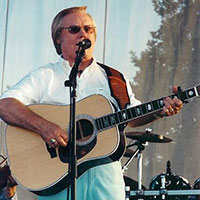
His music was a mixture of cover songs, songs he had written himself, and songs that were co-written with other artists. Jones's first recording to gain national attention was "Why Baby Why ♫" (1955), although the song was later covered by Red Sovine and Webb Pierce, and that version was far more successful than Jones's original. The song gave Jones enough of a reputation that he was invited to perform first on Louisiana Hayride and then on The Grand Ole Opry. The sounds of Acuff's and Williams's influence are evident in Jones's early recordings, but during the late 1950s and early 1960s, producers encouraged him to "sing like George Jones" and embrace his unique sound rather than trying to emulate the styles of his idols. In 1957, he moved to the larger Mercury label and began recording some of his classic honky-tonk recordings. Like earlier honky-tonk music, Jones's songs frequently focus on themes including working-class life, loneliness, and lost love. Jones excelled at both fast, novelty numbers like "White Lightning ♫" (1958) as well as slower tales of unrequited love, such as "Don't Stop the Music ♫" (1957). In the 1960s, Nashville record producers began adding background voices and lush instrumental accompaniments to Jones's songs in post-production, which can be heard in songs such as "A Girl I Used to Know ♫" (1962).
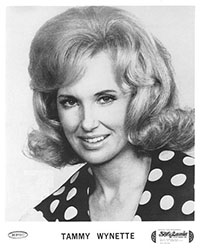
Jones was also well known as a singer of duets with a number of different artists. "We Must Have Been Out of Our Minds ♫," released in 1963, featured George Jones and Melba Montgomery, as well as the dobro and the pedal steel guitar. Jones married fellow country singer Tammy Wynette in 1969, and the two recorded dozens of duets over the course of their marriage. Singles such as "We're Gonna Hold On ♫" (1973) and "Golden Ring ♫" (1976) evoked a sense of commitment and partnership in the lyrics. Unfortunately, the couple divorced in 1975, although their musical partnership would continue intermittently until Wynette's death in 1998.
Jones struggled with alcoholism and addiction throughout his career, often missing appearances or arriving at a show too drunk to perform. Despite his personal struggles, his music continued to succeed. For example, Jones did not chart any number 1 singles between 1974 and 1980, but in 1980, he released "He Stopped Loving Her Today ♫," which was number 1 on the country charts for eighteen weeks. The song, written by Bobby Braddock and Curly Putnam and produced by Billy Sherrill, tells the tale of a man who believes his lost love will return to him one day. The chorus reveals that the man stopped loving her when he died, and his lost love returned for his funeral. In 1999, Jones was seriously injured in a car accident caused by his drunk driving, and he swore off alcohol for good. He continued to record and perform live until his death in 2013.



