
Overview
Objectives
- Identify the defining musical characteristics of hard rock
- Identify the important predecessors and early examples hard rock music and musicians
- Examine Led Zeppelin’s career
- Identify the defining musical characteristics of Led Zeppelin’s style
Hard Rock: Predecessors
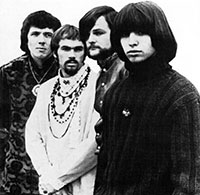
Like a number of major rock genres that developed in the late 1960s and early 1970s, hard rock emerged from the United Kingdom. An offshoot of the British blues revival tradition, hard rock included weighty bass drums, a strong backbeat, and heavy guitar distortion. One of the most defining features of hard rock is its emphasis on a riff-based structure. In earlier rock music, riffs might be featured in the introduction of a song or during a bridge section. In hard rock, riffs became the primary structure around which the entire song would be built. Riffs are heard throughout a hard rock song, except when they drop out in order to focus the attention on an instrumental solo section of music.
British power trio Cream is considered one of the forerunners of hard rock. "Sunshine of Your Love ♫," for example, includes a prominent bass riff throughout the song. In addition, drummer Ginger Baker played two bass drums instead of just one. The bass riff and doubled bass drums created a bottom-heavy sound that would come to characterize hard rock.
Iron Butterfly was another important predecessor of hard rock. Iron Butterfly was a psychedelic band that had formed in San Francisco during the 1960s. Like Jim Morrison and the Doors, Iron Butterfly focused on the darker side of psychedelia, and most of their music is heavy and dense. Their best-known song, "In-a-Gadda-Da-Vida ♫" (1968), is seventeen minutes long and held together by the weighty opening riff. True to the psychedelic movement, "In-a-Gadda-Da-Vida ♫" contains lengthy improvised solos on organ, guitar, bass, and drums.
The American band Vanilla Fudge was another psychedelic rock predecessor of the genre of hard rock. Vanilla Fudge took Brill Building, Motown, or other pop tunes and transformed them into lengthy psychedelic covers. "You Keep Me Hanging On ♫" was a Motown song written by Holland-Dozier-Holland and recorded by the Supremes, but in the hands of Vanilla Fudge, it became a dark, weighty tale with a wide range of volumes and the incorporation of a sitar.



"Led Zeppelin's version [of "Dazed and Confused"] was not credited to Jake Holmes, as Page felt that he changed enough of the melody and added enough new lyrics to escape a plagiarism lawsuit. While Holmes took no action at the time, he did later contact Page regarding the matter. Holmes finally filed a lawsuit in 2010...Holmes settled with Page and the case was dismissed on January 17, 2012."
