
Overview
Objectives
- Identify the defining musical characteristics of hard rock
- Identify the important predecessors and early examples hard rock music and musicians
- Examine Led Zeppelin’s career
- Identify the defining musical characteristics of Led Zeppelin’s style
Hard Rock: Early Examples
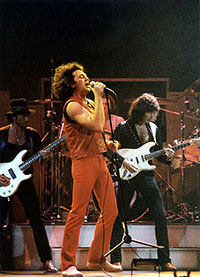
The British group Deep Purple was one of the earliest hard rock bands. The group’s earliest incarnation—keyboardist John Lord, guitarist Ritchie Blackmore, drummer Ian Paice, singer Rod Evans, and bassist Nick Simper—had a single hit, a cover of an American pop tune called "Hush ♫." The group had little success until 1970, when Evans and Simper were replaced with singer Ian Gillan and bassist Roger Glover. This version of the group released three hit albums in a row: Deep Purple in Rock (1970), Fireball (1971), and Machine Head (1971). Machine Head includes the singles "Smoke on the Water ♫" and "Highway Star ♫," both of which are were major hits. "Smoke on the Water ♫" has the riff-based structure that was a hallmark of the hard rock style.
An early American hard rock band was Steppenwolf, who changed their name from Sparrow to the title of a novel by Hermann Hesse. Steppenwolf’s music was riff-based, although they did not always play the riff throughout the entire song as later hard rock bands would. Their high volume and heavy distortion were important parts of the hard rock genre that had been carried over from psychedelic rock. The band’s hardness was indelibly linked with the 1969 film Easy Rider, which included the songs "Born to be Wild ♫" and "The Pusher ♫" in its soundtrack.

"The Pusher ♫," a cover of a song by Hoyt Axton, addressed drug dealing in its lyrics. "Born to be Wild ♫" appeared in the opening credits of Easy Rider, and it is the first song to use the term "heavy metal" in its lyrics. However, the "heavy metal" in "Born to be Wild ♫" is that of a motorcycle, not that of rock music. A heavy riff opens the song and continues underneath the lyrics (except during the middle section of the song when singer John Kay performs the song’s title line). The song has come to be associated with motorcycles and the culture surrounding them.



"In 2010, Mary J. Blige covered "Whole Lotta Love" and "Stairway To Heaven," which were released as downloads and appeared on the UK version of her Stronger With Each Tear album."
