
Overview
In this lesson, we will consider the genres of hard rock and heavy metal, which emerged in the late 1960s and the early 1970s. The genre of hard rock grew out of the psychedelic rock tradition as well as the British blues revival movement. Like psychedelic rock, it focused on loud, distorted electric guitars. Like the blues, it was riff-based. The “hardness” of hard rock came from an emphasis on the bass guitar as well as on the bass drum. Heavy metal was an important outgrowth of hard rock. Also riff-based, heavy metal tended to have darker themes compared to hard rock.
Objectives
- Identify the defining musical characteristics of hard rock
- Identify the defining musical characteristics of heavy metal
- Identify the important predecessors and early examples hard rock music and musicians
- Identify the defining musical characteristics of Led Zeppelin’s style
- Identify the early examples of heavy metal in the United Kingdom and in the United States
British Heavy Metal
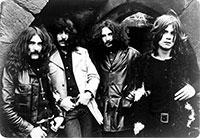
Black Sabbath was one of the first major British heavy metal bands to emerge in the late 1960s. The group's membership included singer Ozzy Osbourne, guitarist Tony Iommi, bassist Geezer Butler, and drummer Bill Ward. Black Sabbath's music from the early 1970s is riff-based, and very often, the voice, guitar, and bass all perform variants of the riff during the song. These layers and repetition add to the heaviness of the sound.
The group's first album, Black Sabbath, was released on Friday February 13, 1970. Critics typically agree that this was the first heavy metal album ever released. The album opens with a track called "Black Sabbath ♫," and the song contains many references to witchcraft, the occult, and the devil.
The riff on which "Black Sabbath ♫" is based is constructed around an interval called a tri-tonethe interval of an augmented fourth or a diminished (or flatted) fifth (for example, the distance between C and F-sharp) that has been used throughout music history to evoke the sinister. A tri-tone is an augmented fourth or a diminished (or flatted) fifth, that is, the distance between C and F-sharp, for example. In church music of the medieval and renaissance periods, the tri-tone was forbidden in all music because it was thought to be the "devil's interval." Although the tri-tone has become commonplace in music over time, it is sometimes used to evoke the sinister in music. Throughout "Black Sabbath ♫," the full riff and the tri-tone interval on which it is based can be heard in the guitar, bass, and in Osbourne's vocal lines. In addition to the tri-tone-based riff, church bells ring during the song and provide a funereal atmosphere.
Despite the album's darkness and heaviness, Black Sabbath does let its blues influences shine through from time to time. Most of the songs are based on blues riffs, and the forms of the songs are standard rock forms. The song "The Wizard ♫" includes a harmonica solo performed by Osbourne, a clear musical link to the group's blues background and experience.
In the early 1970s, Black Sabbath was accused of inciting a young woman to commit suicide when their Paranoid album was found on her turntable after her death. The group was not found responsible for her death, but they continued to fight against accusations that their music caused depression and suicide in its listeners. According to Osbourne, "I never sat down to write lyrics with the intent that anyone should kill themselves. I feel very sorry for those kids. But why can't you sing about suicide? It's a thing that really happens." Black Sabbath again found themselves accused of negatively influencing their listeners when David Berkowitz (the Son of Sam serial killer) claimed that he had listened to Black Sabbath's music extensively. This claim that heavy metal music caused violence or death is a theme that critics would frequently return to during the 1980s and 1990s, as we will see in subsequent lessons.



