
Overview
Not since the early 1960s and the days of Chubby Checker’s “The Twist” and other dance crazes had rock been considered a music for dancing. By the 1970s, most rock was consumed by listening, not by dancing. That all changed with the rise of disco music, which was for dancing. Disco was a stark contrast to rock music in many ways, such as its embrace of the single and the prominent role played by the DJ and record producer in the creation of a disco record. In this lesson, we will consider many cultural and musical influences on disco in order to examine how and why this dance music was the dominant genre of popular music in the United States by the end of the 1970s.
Objectives
- Identify several musical and cultural predecessors of disco music
- Recall the influence of the gay community and the Stonewall Riots on disco music
- Identify several defining features of the style of disco music
- Examine several significant disco artists and their contributions during the 1970s
The Music and Technology of Disco
The figure at the center of all of these clubs was the disc jockey, or DJshort for disc jockey, it refers to the person who would play all the music at discotheques or clubs . (The term DJ will be used in this lesson to avoid confusion with the radio disc jockey discussed in earlier lessons.) During the 1970s, the United States was in the middle of an economic recession, and many club owners did not have enough money to hire a live band and pay the individual musicians. Instead, they hired a single DJ who would play his or her own records at the club all night. The DJ was responsible for playing music that would keep dancers engaged for hours. In order to prevent breaks between songs, DJs developed techniques for blending one song into the next.
For example, the DJ would use two turntables at the same time, fading out one record while introducing another record that had a similar tempo. A continuous stream of music kept people on their feet all night long.
DJs did not play full albums, and they were uninterested in the album orientation of rock music of the time. Instead, they chose popular songs that got people to dance, and they found creative ways to expand and extend these songs to as long as fifteen minutes. In 1975, a producer and DJ named Tom Moulton introduced the 12-inch singlean extended version of the 45 RPM single that could accommodate lengthy versions of popular songs as opposed to the three minute length of most 45 RPM singles , which was an extended version of the 45 RPM single. The 12-inch single could accommodate lengthy versions of popular songs as opposed to the three minute length of most 45 RPM singles. This extended length meant there were fewer breaks in the music and therefore fewer stops imposed on the people dancing.
With disco, the DJ became a star in his or her own right. DJs were placed front and center in the club, often on their own stage. Unlike bands who played guitars, DJs played music on turntables and mixers. Most DJs had two turntables, which allowed them to segue seamlessly between songs, and a mixera device that allowed DJs to transition between different audio sources , which allowed them to transition between different audio sources. Discotheque DJs created a new type of music performance that was built from existing recordings and inspired people to dance. As we will see in later lessons, this emphasis on production and mixing would become an essential component of many later genres of music, especially hip-hop.
A number of singles have vied for the title of the first disco record. MFSB's "Love is the Message ♫" was among the first disco records ever released, and it is considered one of the most popular and influential disco songs recorded. Recorded by Philadelphia International records in 1973, "Love is the Message ♫" has a lush instrumental accompaniment, complete with orchestral strings and funk band winds. Most of the instrumental musicians on this track were studio musicians who worked for Philadelphia International. One of the most important sounds on "Love is the Message ♫" is the drum part, played by studio drummer Earl Young. Young subdivided each beat of the measure on his hi-hat, meaning that the hi-hat is audible both on and in between every beat of the measure.
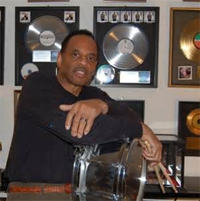
Young's approach to the drum line was widely imitated by other musicians who played on disco tracks, and it came to be known as the disco beata drum beat developed by drummer Earl Young where each beat of the measure is subdivided on the hi-hat, meaning that the hi-hat is audible both on and in between every beat of the measure; this beat was widely imitated by other musicians on disco tracks . Kenneth Gamble and Leon Huff, the owners of Philadelphia International, wrote and produced dozens of hit songs during the 1970s. The so-called Sound of Philadelphia was as important to disco music as Phil Spector's wall of sound had been to girl groups of the 1960s.

“Disco is the first technology music. And what I mean is that 'disco' music is named after discs, because when technology grew to where they didn't need a band in the clubs, the DJ played it on a disc.”


