
Overview
Not since the early 1960s and the days of Chubby Checker’s “The Twist” and other dance crazes had rock been considered a music for dancing. By the 1970s, most rock was consumed by listening, not by dancing. That all changed with the rise of disco music, which was for dancing. Disco was a stark contrast to rock music in many ways, such as its embrace of the single and the prominent role played by the DJ and record producer in the creation of a disco record. In this lesson, we will consider many cultural and musical influences on disco in order to examine how and why this dance music was the dominant genre of popular music in the United States by the end of the 1970s.
Objectives
- Identify several musical and cultural predecessors of disco music
- Recall the influence of the gay community and the Stonewall Riots on disco music
- Identify several defining features of the style of disco music
- Examine several significant disco artists and their contributions during the 1970s
The Music and Technology of Disco continued
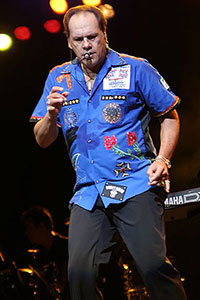
Another important early disco band was the Florida-based KC and the Sunshine Band. After writing and producing George McRae's 1974 hit single "Rock Your Baby ♫," Harry Wayne "KC" Casey and Richard Finch created the nine-piece KC and the Sunshine Band. The group recorded several disco hits penned and produced by Casey and Finch, including "(Shake, Shake, Shake) Shake Your Booty ♫" (1976) and "Get Down Tonight ♫" (1975).
Although the sounds and styles of disco music can vary, all disco music is marked by its prevalent and incessant beat. The music of disco is marked by a specific type of beat called four on the floora bass drum pattern prevalent in disco and other dance music; features bass drum kicks on each beat in a 4/4 measure; create a pattern of 1-2-3-4. In a four on the floor beat, the bass drum hits uniformly on every beat of the measure.The instruments can change, the songs can be about various subjects, the singer can be male, female, or an ensemble, but the four on the floor beat is always present. The beat of disco comes from its use as a dance music, because without a beat, the dancers have nothing to dance to.
Further, most disco tunes are roughly the same tempo. The tempo similarities were both because people did not want to dance to music that was either too fast or too slow and also because DJs needed to make seamless segues between different singles that they were playing. Similar tempos allowed the DJ to change from one song to another without forcing the dancers to have to stop or make much of a change to their dancing. In fact, many disco songs of the era listed their tempo on the record itself in the form of beats per minute, or BPM. Most disco songs fall somewhere between 100 and 130 beats per minute. (In fact, the Bee Gees' "Stayin' Alive ♫," at 103 beats per minute, is used as a medical training tool because cardiac chest compressions should be delivered at a rate of 100 per minute.) These BPM labels helped DJs choose records that would fit together for continuous club play.
In general, most disco songs do not deal with complex or controversial topics. Because disco was a music for dancing instead of for listening, the lyrics did not need to be analyzed. Both the messages and the forms are relatively straightforward. Many disco songs are verse-chorus or simple verse form, with plenty of repetition. A steady beat, repetitive musical themes, and a reliable formal structure are all critical components of any dance music because they allow people to dance without having to anticipate unusual changes.
Disco records initially became popular because of club play, not because they were played on the radio. Singles such as Manu Dibango's "Soul Makossa ♫" (1973) and Carl Douglas's "Kung Fu Fighting ♫" (1974) became popular and sold well because they were played heavily in clubs. Record companies would disseminate advance copies of a record to DJs to test on the dance floor before they released the records commercially. In 1974, the New York radio station WPIX began to air a Saturday night disco and dance music show, and by 1976, the show was played nightly. WBLS began playing disco alongside the other genres of music on its playlists. Soon, other radio stations followed the leads of these two stations in order to remain competitive. When WKTU in New York converted to an all-disco format, it went from a 0.9 share of the market to an 11.3 share. By the end of the decade, disco would be the dominant genre popular music in the United States, eclipsing rock, funk, and other types of pop.

“Disco is the first technology music. And what I mean is that 'disco' music is named after discs, because when technology grew to where they didn't need a band in the clubs, the DJ played it on a disc.”


