
Overview
In the late 1960s and early 1970s, many Americans were listening to psychedelic music, folk rock, funk, and pop. At the same time, a new genre of music was developing in the underground scenes of the United States and the United Kingdom: punk. Punks rebelled against pretentious, over-produced rock stars and the corporations that promoted them. Instead, punk musicians focused on being as anti-corporate as possible. Punk music’s lyrics often emphasize a sense of isolation and alienation from everyday human emotions and issues. The genre of New Wave arose in the late 1970s as the aloof cousin of punk rock. New Wave music maintained a sense of detachment and alienation, but it often included musical language that was more familiar and relatable than that repetitive, distorted, screamed sounds of punk rock. A number of New Wave artists frequently turned to the music of the 1950s and 1960s for inspiration.
Objectives
- Identify several important proto-punk groups and artists
- Recall how and why New York was the center of the emerging punk rock movement
- Recall how the music of punk rock musicians reflects their aesthetic and social values
- Identify the similarities and differences between punk rock and New Wave
- Recall the significance of CBGB in the early careers of New Wave bands such as Talking Heads and Blondie
- Examine the role of earlier styles of rock and popular music in the recordings of groups such as the B52s and the Cars
The Musical Language of New Wave
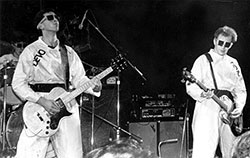
New Wave musicians, like punk rockers, were anti-establishment and interested in themes of alienation and isolation. Unlike a lot of punk rock, though, New Wave music was artsy, ironic, introspective, and clever. Many musicians in the New Wave movement had backgrounds in the visual arts, which lent them a sense of authenticity as far as listeners and record labels were concerned.
Most punk rock groups included only guitars, bass, and drums, but new wave groups often had synthesizers, keyboards, saxophones, and other wind instruments. The sense of perpetual motion that punk rockers achieved by strumming the guitar forcefully was replaced by the repetition of notes on the bass. The bass or guitar riffs in New Wave are more melodic than the riffs of punk. New Wave also rejected punk's embrace of distortion, instead focusing on clear, clean sounds and articulations. Many new wave bands retained the limited vocal range and speech-like singing style of punk rock. In contrast, though, new wave artists did not scream or yell about their discontent. Instead, they were cool and reserved, singing as if they were completely unconcerned.
The music and attitudes of New Wave are expertly captured by the band Devo. Devo was formed in 1975 by Jerry Casale and Mark Mothersbaugh. Casale and Mothersbaugh were art students at Kent State University who needed to create a soundtrack for The Truth About De-Evolution, a film they had produced. The group's name, Devo, was an abbreviation of "de-evolution." Devo's first single was "Mongoloid ♫," and the B side, "Jocko Homo ♫." "Jocko Homo ♫" became Devo's anthem, and it includes a chorus in which the musicians constantly ask and answer the question, "Are we not men? We are Devo." This line, which became an anthem during Devo's live shows, emphasizes that Devo (de-evolution) is not human. "Jocko Homo ♫" has absurd lyrics that deal abstractly with issues of technology and evolution. The instrumental parts are synthesized and repetitive, which also suggests detachment from human emotions.
Devo was signed to Warner Brothers Records and released their first album, Are We Not Men?: We Are Devo! in 1977. Devo, like a number of punk bands and New Wave bands, was more commercially successful in England than in the United States, at least at first. Their music often addressed the fact that people had become over-dependent on machines and computers, which in turn dehumanized them. This theme of dehumanization and detachment was common both in Devo's music and in the music of other New Wave bands. In 1980, the group released its third album, Freedom of Choice, which featured the single "Whip It ♫." "Whip It ♫" includes a Mini Moog synthesizer that was made specifically for Devo by Moog Music. Although the lyrics were often mistaken to be references to violence, masturbation, or the abuse of household inhalants, the group maintains that "Whip It ♫" is a satirical take on the idea of overcoming adversity. Any problem can be overcome quickly if one simply "moves forward" and "gets straight."


“DEVO was like the punk band that non Punk America saw as Punk and so when people who were really into Punk rock would be walking around on the streets the jocks who learned about Punk through Devo would roll down their windows and yell at the Punks: 'HEY, DEVO!!'”

