
Overview
Objectives
- Identify the aesthetics of glam rock
- Identify several important figures in the early glam rock movement
- Examine how the artists in this lesson exhibited glam rock aesthetics in their performances
Queen
During the 1970s, the British band Queen combined the drama and intellectualism of progressive rock with the theatrical components of glam rock. Led by singer and songwriter Freddie Mercury, Queen also included guitarist Brian May, bassist John Deacon, and drummer Roger Meadows-Taylor. The group’s music contained studio techniques such as overdubbed guitar parts, and the recordings often featured four-part vocal harmony. Mercury was a flamboyant stage performer, often wearing extravagant costumes onstage or performing without a shirt. He used a bottomless microphone microphone stand that is not attached to a base and which must be carried by the singer during the performances , that is, a microphone that is not attached to the stand and which must be carried by the singer during the performances. By using a bottomless microphone, Mercury was free to travel the full length of the stage.
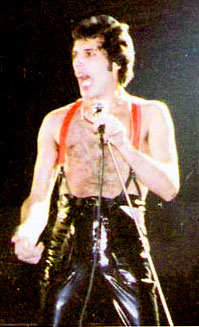
Mercury was able to encourage crowd participation on a grand scale: during a 1985 performance at Live Aid, Mercury engaged over 70,000 people into clapping and singing with him.
Queen’s most ambitious project was the 1974 album A Night at the Opera. At the time of its release, it was the most expensive album that had ever been produced by any group. The album includes songs that were written by all four members of the band, including Meadows-Taylor’s "I’m in Love with My Car ♫," Deacon’s "You’re My Best Friend ♫," and May’s "39 ♫." According to May, "39 ♫" was a song in the style of "sci-fi skiffle," and it addressed themes of loneliness and isolation experienced by astronauts who have been away on a voyage. The songs on A Night at the Opera were very diverse in style, tone, and subject.
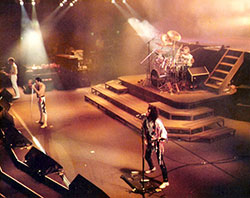
The most famous single from A Night at the Opera was "Bohemian Rhapsody ♫," which was a self-contained story. In classical music, a rhapsody a form found in classical music where a piece has an irregular form, but all of the individual sections within the form are related to each other is a piece with an irregular form, but all of the individual sections of the form are related to each other. (Sergei Rachmaninoff’s Rhapsody on a Theme of Paganini and George Gershwin’s Rhapsody in Blue are two famous examples of classical rhapsodies.) The song unfolds in a series of sections that tell the tale of a murderer.
The "role" of the murderer in the song is played by Mercury. The elaborate vocals in the song were created by overdubbing the voices of Mercury, Meadows-Taylor, and May. The group also created a video to promote the song, which was relatively uncommon in the 1970s; not until the advent of Music Television (MTV) in 1981 did musicians began creating music videos on a regular basis for the singles they released.
During the early 1980s, Queen lessened the drama of their recorded music. They shifted toward an increasingly blues-oriented style in "Crazy Little Thing Called Love ♫" (1980) and a funk-inflected sound in "Another One Bites the Dust ♫" (1980). Queen did not abandon its glam roots, however; the band joined with David Bowie in 1981 to record the hit single "Under Pressure ♫." Mercury continued to perform with the same enthusiasm and showmanship even as the group’s style changed.
Like Elton John, Freddie Mercury was gay and closeted until the 1980s. Although critics and reporters frequently speculated about Mercury’s sexual orientation, particularly in light of his onstage showmanship and his affinity for opera, Mercury remained mum on the subject. Mercury died of AIDS in 1991, only a day after announcing that he had the disease. At the time of his death, he was living with his male partner of several years.
After Mercury’s death, the remaining members of the band staged a memorial concert for him. This concert, a release of Greatest Hits, and the appearance of "Bohemian Rhapsody ♫" in the 1992 film Wayne’s World all contributed to a resurgence in popularity for the group in the early 1990s.



"David Bowie drew, sculpted and painted in his spare time. His favorite artists included Tintoretto, John Bellany, Erich Heckel and Picasso."
