
Overview
As the term “disco” lost favor in the late 1970s and early 1980s, different types of dance music continued to develop and be played in clubs in the Midwest, especially in Chicago and Detroit. The first important genre of dance music to develop during this period was Chicago house, and this music strongly influenced musicians in the nearby city of Detroit. Young African American musicians from Detroit would travel to Chicago every weekend to hear house music, and they began creating their own style of and approach to electronic dance music at home. This genre of music came to be called techno. Musicians created techno with electronic instruments such as synthesizers, computers, samplers, drum machines, and multi-track mixers.
Objectives
- Recall several important technological developments and instruments from the late 1970s and early 1980s
- Identify the musical predecessors of Detroit techno music
- Recall the musical and socioeconomic factors that led to the development of Detroit techno
- Examine the development and dissemination of techno into the 1990s
Chicago House Music
Another important predecessor of techno was house musica type of dance music in which DJs manipulated existing records to create new sounds. They played the same passage end-to-end, layered sounds from different types of records, or added new drum beats to an existing recording .House music developed only slightly earlier than techno, and the two genres grew alongside each other during the 1980s. However, house played an important role in the development of techno even though it was only a few years older.
In 1977, the Waterhouse Club opened in Chicago, and it was the first dance club that catered to gay African Americans. The Warehouse featured DJ Frankie Knuckles, who had been raised in New York but relocated to Chicago. Knuckles and the Warehouse initiated a new era in Chicago by providing otherwise marginalized people with a place to dance and party. Initially a disco club, the Warehouse and its DJs began shying away from disco in 1979.
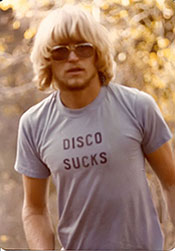
Recall that a Chicago DJ encouraged hundreds of attendees at Comiskey Park to bomb disco records to the chants of, "Disco sucks!" As "disco sucks" caught on as both a catchphrase and an attitude, record labels began to avoid the term "disco" at all costs. As a result, there were fewer and fewer records for DJs such as Knuckles to draw from for new material.
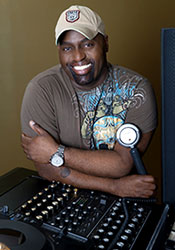
Some DJs began purchasing European dance records in order to provide club-goers with new songs. But, these European records were expensive to purchase and often difficult to obtain. As a result, DJs such as Knuckles became increasingly creative and innovative in the ways they manipulated existing records. They added effects and techniques to create new sounds from existing recordings. They would isolate selected passages from their favorite songs and play them end-to-end using reel to reel tape. Knuckles would layer sounds from different genres of records, or he would play a new beat that he had created on a Roland TR-808 drum machine over an existing recorded track. Knuckles would also manipulate existing dance records to emphasize the drums and bass as strongly as possible, often completely obscuring or turning down the lyrics. According to Knuckles, "I had to reconstruct the records to work for my dance floor because there was no [new] dance music coming out.
I'd take existing songs, change the tempo, or layer different bits of percussion over them." By 1984, this style of dance music was called "house," both because it originated in Knuckles's club The Warehouse and because the new records were created and edited in home studios by the DJs.

"I happen to think that computers are the most important thing to happen to musicians since the invention of cat-gut which was a long time ago."


