
Overview
Objectives
- Identify the aesthetic and social values of the punk rock movement
- Identify several important proto-punk groups and artists
- Examine how and why New York was the center of the emerging punk rock movement
- Recall how the music of punk rock musicians reflects their aesthetic and social values
New York Punk
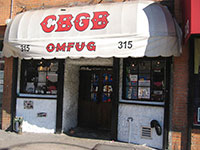
In New York’s Bowery District, the club Country, Blues Grass, Blues, and Other Music For Uplifting Gormandizers—typically shortened to CBGB & OMFUG or simply CBGB short for Country, Blues Grass, Blues, and Other Music For Uplifting Gormandizers, CBGB was a club in New York’s Bowery District that served as the center of the New York punk movement in the 1970s —was the center of the New York punk movement in the 1970s. A number of early punk groups, including Television, the Patti Smith Group, and the Ramones started their careers at CBGB.
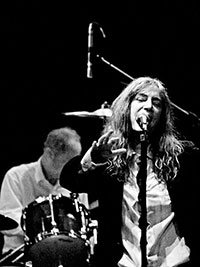
The first group from the New York punk scene to sign with a major record label was the Patti Smith Group. The Patti Smith Group included singer and poet Patti Smith, guitarist Lenny Kaye, bassist Ivan Krahl, pianist Richard Sohl, and drummer Jay Dee Daugherty. Before the formation of the Patti Smith Group, Smith and Kaye had performed together in New York clubs during the early 1970s. They had already established Smith’s reputation as a poet before the band was formed in 1974. The group’s first album, Horses, was released by Arista Records in 1975, and it was produced by John Cale of the Velvet Underground. The album features a mix of covers and songs written by Smith and the other members of the group. The single "Gloria ♫" is a cover of a Van Morrison song, but Smith made significant changes to the lyrics. Only the chorus lyrics are unchanged from the original. "Gloria ♫" opens with Smith singing in a low range and accompanied only by the acoustic piano. The song builds in intensity and adds the remaining instruments. True to the aesthetics of the punk movement, Smith sings, "People say beware, but I don’t care."
Smith wanted to shock listeners with her energy, gender non-conformity, and aggression. "Gloria ♫," for example, is a song from a male point of view, and Smith embraced the discomfort or anger that listeners might experience when hearing the song performed by a woman. Similarly, Smith covered the Who’s "My Generation ♫" (discussed during the lesson on the British Invasion). Smith’s "My Generation ♫" was heavier, angrier, and more obscene than the Who’s original. In the live recording, Smith’s voice cracks as she screams the lyrics and tells the listener exactly what she does and does not need. Often, the microphone squeals as her voice overpowers it. Smith and her group were able to convey messages that were angry and disinterested, masculine and feminine, subtle and over-the-top.
The Sunday evening spot at CBGB was occupied by the band Television. Television had two members: singer and guitarist Tom Verlaine and bassist Richard Hell. Verlaine took his stage name from the nineteenth-century French symbolist poet Paul Verlaine, whose art frequently made use of metaphors and symbols. Tom Verlaine incorporated these elements into his lyrics as a tribute to the poet. Hell dressed in ripped clothing and wore his hair spiked, a look that would be adopted by British punk musicians. The music Verlaine and Hell wrote for Television had a melodic guitar line, improvisations inspired by psychedelic rock, and a lack of formal cohesiveness inspired by the music of the Velvet Underground. Songs such as "Blank Generation ♫" (1977) reflected a sense of nihilism that was common in punk music of the period.



"In 1979, [the Ramones] starred in the movie Rock And Roll High School. In the film, students try to get tickets to a Ramones show and end up taking over the school."
