
Overview
Objectives
- Identify the aesthetic and social values of the punk rock movement
- Identify several important proto-punk groups and artists
- Examine how and why New York was the center of the emerging punk rock movement
- Recall how the music of punk rock musicians reflects their aesthetic and social values
New York Punk continued
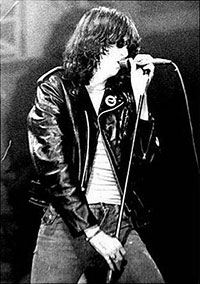
One of the most influential bands to come out of the New York scene in the mid-1970s was the Ramones. All of the band members adopted "Ramone" as their last name, including singer Joey Ramone, guitarist Johnny Ramone, bassist Dee Dee Ramone, and drummer Tommy Ramone. None of the musicians were particularly skilled, and the group embraced this mediocrity. According to Johnny Ramone, "I had bought my first guitar just prior to joining the Ramones. We put records on, but we couldn’t figure out how to play the songs, so we decided to start writing songs that were within our capabilities." The Ramones were, in many ways, rebelling against the complexities of progressive rock. As a result, they were proud to play uncomplicated music that was easy to understand.
Most of the Ramones’ songs were under three minutes long. They performed at deafening volumes. The songs were played at high speeds and had simple, straightforward instrumental accompaniments. Johnny Ramone rarely played guitar solos. Joey Ramone’s vocals were sung in a near monotone, which would become a model for later punk bands. All of these characteristics can be heard in "Blitzkreig Bop ♫" (1976), which is among the group’s best-known songs. The song features a limited number of guitar chords that are repeated over and over throughout the song. The lyrics and the vocal melodies are repetitive and limited to a few pitches. Underlying the entire song is a heavy, propulsive drumbeat. "Blitzkreig Bop ♫" appeared on the Ramones’ eponymous album that was released on the New York label Sire Records.
The Ramones’ lyrics were contrarian and rejected the values of the middle class and of mainstream society. Consider the lyrics of "I’m Against It ♫" (1978):
I don’t like water bugs
I don’t care about poverty
I don’t like playing ping pong
I don’t like the Viet Cong
I don’t like anything.
In this song, Joey Ramone laid out a list of items, activities, and institutions that many people felt passionate about and dismissed them one by one. They also recorded a number of songs about things that they did not want to do: "I Don’t Care ♫" (1977), "I Don’t Wanna Walk Around with You ♫" (1976), and "I Don’t Want To Go Down to the Basement ♫" (1976). According to Dee Dee Ramone, the first positive song the Ramones wrote was "Now I Wanna Sniff Some Glue ♫" (1976). In their music and attitude, the Ramones rejected mainstream values and were passionate about their apathy.
As important as the Ramones were on the development and dissemination of punk rock, they never had an album reach the Top 40 in the United States. The Ramones only went as far as number 111 on the Billboard charts. They had far more success in the United Kingdom, both in terms of record sales and in the reception at their live performances. Their single "Sheena is a Punk Rocker ♫" reached the Top 40 in the UK, for example. The presence of the Ramones in the United Kingdom sparked the beginning of the British punk music, a topic which will be taken up in the next lesson.



"In 1979, [the Ramones] starred in the movie Rock And Roll High School. In the film, students try to get tickets to a Ramones show and end up taking over the school."
