
Overview
In the early 1980s, the massive deregulation of television broadcasting led to an expansion of cable TV services throughout the United States. These cable providers carried a number of specialized channels for their subscribers. On August 1, 1981, Warner Communications and the American Express Company launched MTV, the first 24-hour music video cable channel. By 1983, MTV had expanded from 2.5 million initial subscribers to 17 million, making it the fastest growing cable channel in history. Airing videos on MTV was a way for artists and record companies to promote their music. By 1983, nearly all of the albums on the Billboard albums chart had at least one song in heavy rotation on MTV. MTV became the new way to advertise music to consumers.
Objectives
- Recall the development of MTV during the 1980s
- Examine the significance of the Second British Invasion as it related to MTV
- Examine the role Michael Jackson played in eliminating the color lines on MTV
- Recall how Madonna pushed musical and visual boundaries in her music and videos
A Second British Invasion?
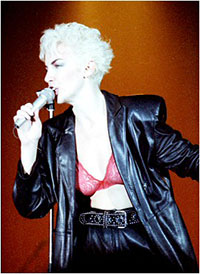
Many British artists were accustomed to using television to promote their music because the market for new music in the United Kingdom was so different from that in the United States. The United Kingdom had far fewer radio stations compared to the United States, which made it difficult for British artists to gain exposure through that particular medium. Television programs such as Top of the Pops gave British musicians access to audiences at home. MTV offered a way for British groups to reach American audiences without having to tour. American tours were expensive, and they were no guarantee that the band would succeed even if they could afford a tour. The early music videos by British groups were thought of as promotional tools for the band and for the song, and the production techniques echo those of advertisements: changing camera angles, flashy visuals, rapid changes and cuts, and over-the-top special effects.
During its early years, MTV played the music of so many British artists and helped so many British artists succeed in the United States that this period is often referred to as a second British Invasion. The very first video played on MTV was "Video Killed the Radio Star ♫," which was a 1979 song by the British group the Buggles. Thanks to heavy MTV exposure, Human League's "Don't You Want Me? ♫" (1981) went to number 1 in the United States, and other British groups such as Billy Idol, Flock of Seagulls, and New Order had huge commercial success with American audiences and consumers.
The British music of this period was less rock than it was a pop-oriented mix of synthesized instruments, pop-oriented vocals, and disco-inspired glamor. This genre of music came to be called New RomanticismBritish music of the early 1980s that was less rock than it was a pop-oriented mix of synthesized instruments, pop-oriented vocals, and disco-inspired glamour; examples include the Eurythmics and Boy George . Synthesizers had become less expensive, and they were the primary source of instrumental sounds for many bands of the period. Some artists played with gender norms in their visual presentations. Annie Lennox of the Eurythmics frequently dressed androgynously in videos for "Love is a Stranger ♫" (1982) and "Sweet Dreams Are Made of This ♫" (1983). Boy George, the lead singer of Culture Club, frequently wore heavy makeup and women's clothing in videos for songs such as "Do You Really Want to Hurt Me ♫" (1982) and "Karma Chameleon ♫" (1983).

“Music videos may seem old hat now, but let me tell you, in the summer of 1981, MTV was indubitably the coolest thing ever invented. And the people who were in the videos... coolest people ever. No question.”


