
Overview
Objectives
- Examine the relationship between music and the American civil rights movement during the 1960s
- Identify characteristics of Brown’s musical style from this period
- Identify some of the defining features and characteristics of funk music
- Recall the significance of Sly and the Family Stone in the development of funk music
- Examine the role George Clinton played in funk music during the 1970s with P-funk genre
- Examine how popular media such as Blaxploitation films and television programs helped promote African American music and musicians
James Brown’s Band
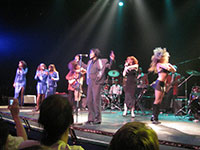
Brown’s lyrics and stage presence were a critical part of the music that he recorded, but his band also played a crucial role in his sound of the period. Brown was usually backed by guitar, bass, drums, and a horn section of saxophones, trombones, and trumpets. Saxophonist Maceo Parker, trombonist Fred Wesley, sideman Bobby Byrd, and saxophonist Pee Wee Ellis were just a few of the musicians in Brown’s band who recorded with their own bands in addition to Brown’s. Most of the musicians are credited as co-authors of many of Brown’s songs.
In the music Brown and his band recorded during this period, the musicians would play riffs. Unlike the blues or rock, in which a single riff can form the foundation of the entire song, each instrument or group of instruments would play interlocking riffs. Each riff had independent interest, and when combined, the interlocking riffs created intricate rhythmic patterns. In rehearsals, the musicians would often start with the drummer’s line, and then they would keep adding riffs until they locked into the song’s groove a term used in funk music that refers to the repeated pattern that is created when all of the separate riffs played by the various instruments coalesce with the drummer’s rhythm and are repeated . In funk music, the groove refers to the repeated pattern that is created when all of the separate riffs coalesce and are repeated. Once the band established the groove, Brown would add the lyrics, and the band would work out the breaks and stops accordingly.
"Cold Sweat ♫" (1967), co-written by Brown and Pee Wee Ellis, is typically regarded by critics as the first funk song ever recorded. "Cold Sweat ♫" also is one of Brown’s first recordings that contains a drum break. In a drum break a section in a song where the rest of the musicians drop out and the drummer (or the rhythm section) plays for one or two measures , the rest of the musicians drop out and the drummer (or the rhythm section) plays for one or two measures. In "Cold Sweat ♫," the drum break, played by drummer Clyde Stubblefield, can be heard at 4:30 in the song. The drum break allowed the drummer to shine.
James Brown is often credited with beginning the transition from soul to funk in the late 1960s. As we will see, funk became the most popular genre of African American music during the 1970s.

“Soul was the music made by and for black people. For most of the Sixties it was thoroughly divorced from white popular music, but by the end of the decade several artists with their roots firmly in both soul and R&B traditions had crossed over.”

“You go through the Civil Rights struggle, everybody knew the songs - 'We shall overcome.' Everybody would sing it. Music helped us. James Brown, 'Say It Loud - I'm Black and I'm Proud.' They helped black people figure out how to navigate what was a very treacherous place in America for them.”

"Carmen Electra, Nick Cannon, MC Hammer and Laurieann Gibson were among the "Soul Train" dancers who got their first taste of fame on the show."
