
Overview
By the late 1980s and early 1990s, hip-hop had become increasingly diverse in its sounds, styles, and messages. In this lesson, we will survey several major styles of hip-hop that were popular at the end of the 1980s, including political hip-hop, pop rap, gangsta rap, and sample-based hip-hop. By this time, hip-hop ran the gamut from family-friendly pop rappers such as MC Hammer to the hard, streetwise tales spun by the members of N.W.A.
Objectives
- Identify the characteristics of several styles and subgenres of hip-hop from the late 1980s and early 1990s, including political hip-hop, sample-based hip-hop, gangsta rap, and pop rap
- Recall the significance of sampling in the music of groups such as De La Soul, the Beastie Boys, and Public Enemy
- Recall why some pop rap artists such as MC Hammer were accused of “selling out” when their music had crossover appeal
Gangsta Rap
Other hip-hop artists in the late 1980s and early 1990s rapped in a style called gangsta rapa style of hip hop that emerged in the late 1980s and early 1990s that celebrated violence, drug use, gang activity, and, often, the disrespect of women; an important early gangsta rap group was N.W.A. , which often celebrated violence, drug use, gang activity, and, often, the disrespect of women. Gangsta rap values both authenticity and impenetrability, and many rappers in this genre tell tales of control, power, and dominance. Although this genre is also sometimes called "reality rap" because it was thought to convey the reality experienced by the musicians who performed it, many gangsta rap songs and albums blend true stories with exaggerations and fiction. According to gangsta rapper Ice-T, "You got to know what's real. We fade from reality to fiction to reality to outrageousness to totally serious in the middle of sentence. And you got to say, ‘Oh, he's talking crazy right there, oh, he meant that.'" Gangsta rap often drew criticism from those who believed that the music and lyrics incited violence.
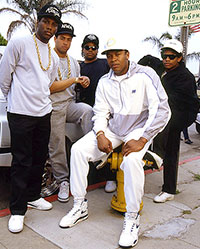
Early gangsta rap groups such as N.W.A. (N----- with Attitude) came from the West Coast. The members of N.W.A. lived in Compton, a Los Angeles suburb that was impoverished and overrun with gang and drug activity during the 1980s. The members of N.W.A. included Eazy-E, Dr. Dre, Ice Cube, DJ Yella, MC Ren, and the D.O.C. Their first single, "Boyz-n-the-Hood ♫," recorded in 1986, was based on a poem that Ice Cube had written in his high school English class. N.W.A. pressed copies of "Boyz-n-the-Hood ♫" themselves, and they also made cassette tapes of the song to sell. The group gained a strong local following in Los Angeles, and copies of their tapes found their way across the country. N.W.A. eventually signed with a small independent label called Priority Records and released their first album.
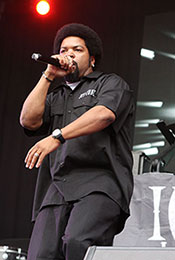
N.W.A. rapped tales that blurred the lines of fantasy and reality in their debut album Straight Outta Compton (1988). Most of their music was produced by Dr. Dre, who blended one or two looped samples with beats created on a drum machine. In singles such as "Gangsta Gangsta ♫" and "Straight Outta Compton ♫," the members of N.W.A. rap about life in Compton as well as imagined scenarios. In their single "F--- tha Police ♫," for example, the verses of the song are separated with courtroom skits in which the members of the group confront and defeat corrupt, racist police officers. The references to drugs and violence, as well as the explicit lyrics, kept the music of N.W.A. off MTV and radio stations, but, thanks to word of mouth, their music still sold well. The group drew fire from critics and the FBI, accused of encouraging violence, although the members of N.W.A. maintain that they were using their music as an outlet for their anger and frustration. As Ice Cube explained, "N.W.A. was simply coming from the heart, not trying to be rebellious or dark, just trying to do exciting music. There was a lot of gang violence in our neighborhood, so that tension got onto the record."
Several members of N.W.A. went on to have successful solo careers, perhaps most notably the producer and rapper Dr. Dre. Dr. Dre not only had a successful solo career but also produced albums by a number of artists such as Snoop (Doggy) Dogg and Eminem. Ice Cube has built a successful career as a solo rapper and as a film star, making his debut in the film Boyz n the Hood (1992), which was named after the N.W.A. single.


"People forget how dominant Public Enemy became in the mid '80s. No one talks about how transformative they were. "

