
Overview
The genre of alternative rock emerged during the 1980s in the wake of punk rock, new wave, and music released on independent labels. In this lesson, we will consider the origins of alternative rock and two of the most successful early alternative rock bands. We will then survey several major subsets of the alternative rock movement that were popular in the early 1990s, including grunge rock, the riotgrrrl movement, and jam bands. The music of alternative rock is bound not by a specific sound or musical style but rather by a rejection of corporate or commercial values.
Objectives
- Recall the primary values and ideas of alternative rock
- Identify the main stylistic and aesthetic elements of grunge rock
- Identify the main stylistic and aesthetic elements of the riotgrrrl movement
- Identify the main stylistic and aesthetic elements of jam bands
Grunge Rock

Sonic Youth's heavy emphasis on guitars was a major influence on the music of the Seattle grunge rocka genre of alternative rock centered in Seattle that used angry angst-filled lyrics and guitar-driven sounds to promote a viewpoint that was anti-establishment, anti-heavy metal, anti-hard rock, and anti-commercialism scene. Grunge rockers were anti-establishment, anti-heavy metal, anti-hard rock, and anti-commercialism. Their lyrics were angry and filled with angst, and their sounds guitar-driven.
Seattle had been an epicenter of alternative rock since the early 1980s. At the center of Seattle's alternative music scene was the independent record label Sub Pop.Founded in 1987 by disc jockey and critic Bruce Pavitt and disc jockey Jonathan Poneman, Sub Pop began as a fanzine and became a powerful presence for many emerging Seattle bands.
One of Pavitt and Poneman's first projects was a three-record collection called Sub Pop 200, which featured music from 20 different Seattle bands, including Soundgarden, Cat Butt, and Nirvana. Pavitt and Poneman promoted the music and Seattle itself as untouched by commercial influences, which only increased the allure of Seattle for musicians eager to join the alternative music scene.
The most iconic band to emerge from Seattle's grunge rock scene was Nirvana. Singer and guitarist Kurt Cobain and bassist Krist Novoselic met in a small, economically depressed Washington town about a hundred miles from Seattle, and they were heavily influenced by the sounds of Seattle's growing alternative rock scene. After several unsuccessful attempts to find a drummer, Cobain and Novoselic finally added Dave Grohl, who would remain with the group until its demise. Nirvana's music was driven by Cobain's guitar playing and lyrics. The guitar sounds of Nirvana have influences of heavy metal's weight, punk rock's distortion, and the catchy melodic hooks. Cobain's lyrics were deeply serious, often critical of institutions and individuals, and he was strongly opposed to the idea of the commercial "rock star."
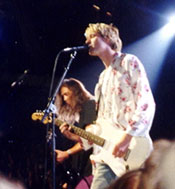
They signed with Sub Pop in 1988 and released their debut album Bleach the following year. Bleach sold 35,000 copies in and around Seattle, which was an impressive amount for a local band. Bleach had a raw, unpolished sound, characterized by early singles such as "Love Buzz ♫."
In 1991, Nirvana signed with the major label DGC, and they also opened for Sonic Youth during a European tour. Their album Nevermind was released in September of 1991, and the initial shipment of 50,000 copies sold out almost instantly. The album retained the intense, hook-oriented style of Bleach, but the production values were far higher and Nevermind sounded more polished than Nirvana's earlier recordings. By early 1992, Nevermind had displaced the Michael Jackson album Dangerous from the number 1 spot on the albums chart, and it stayed on the albums charts for over four years.

“The nineties as a pop cultural sphere was a really fertile time for feminism that was grounded and located in popular culture. I'm talking about before the Spice Girls - Sassy Magazine, riot grrrl, the Beastie Boys, Nirvana. You had this alternative culture that was very much speaking up on behalf of women and in favor of women.”


