
Overview
Objectives
- Recall the new developments in heavy metal music that occurred in the mid-1970s in the music of bands such as Motörhead
- Identify several significant American and British heavy metal bands from the early 1980s
- Recall the major subgenres of heavy metal, including hair metal and thrash metal, and discuss the stylistic characteristics of each
American Heavy Metal
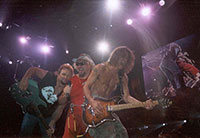
At the same time that Judas Priest, Iron Maiden, and Def Leppard were representing the British heavy metal scene, several American bands were trying their hand at heavy metal music. Aerosmith formed in 1970 and spent their first few years of their existence as a blues revival band in the style of the Rolling Stones. The group did not cover blues songs, however; singer Steven Tyler and guitarist Joe Perry wrote new blues-style songs for Aerosmith to perform.
The members of Aerosmith were not averse to including elements of folk music and country music in their songs, either. Their single "Dream On ♫" (1973) features electric guitars played in the style of acoustic folk guitar playing, but heavily amplified and distorted guitar sounds are introduced later in the song that sound more like hard rock than folk music. In "Walk this Way ♫" (1975), Aerosmith blended rock’s backbeat (emphasis on beats 2 and 4) with blues-styled guitar riffs. Aerosmith’s popularity faded in the early 1980s, but they experienced revived interest in their music when Tyler and Perry re-recorded "Walk This Way ♫" with hip-hop group Run-DMC in 1986.
One of the most successful American heavy metal bands of the 1970s and early 1980s was Van Halen. Founded by brothers Eddie and Alex Van Halen in 1974, Van Halen’s members also included singer David Lee Roth and bassist Michael Anthony. Guitarist Eddie Van Halen had extensive training in classical piano and guitar, and he used his knowledge to create innovate approaches to playing the guitar. He is often regarded as one of the greatest guitar players of rock music. He tapped both of his hands on the neck of his guitar; this technique can be heard in the instrumental track "Eruption ♫" (1978). He created volume swells a guitar technique used by Eddie Van Halen that consists of hammering notes on the fret board with one hand and changing the volume knob with the other hand; the resulting sound on the guitar that was very similar to that of a keyboard by hammering notes on the fret board with one hand and changing the volume knob with the other hand, and this technique created a sound on the guitar that was very similar to that of a keyboard. He created and patented a support device that attaches to the back of the guitar and allowed him to turn the face of the guitar upward and play it like a keyboard. Eddie Van Halen also did not shy away from using an actual keyboard in the band’s music. For example, their hit single "Jump ♫" (1984) prominently featured a synthesizer rather than a guitar. Although Eddie Van Halen had some concerns about how metal enthusiasts would react to the presence of a synthesizer in their music, "Jump ♫" ended up selling well among metal fans and mainstream audiences alike.
Eddie Van Halen’s electrifying guitar techniques were rivaled by David Lee Roth’s stage presence. The two musicians constantly battled for stage dominance and were unable to resolve their differences, so in 1985, Roth left Van Halen and was replaced by Sammy Hagar. Roth returned for a short time in 1996, but he was soon fired again and replaced with a third singer, Gary Cherone. Cherone left in 2004, and Hagar rejoined the band. This lineup continues to record and perform to this day.

“My biggest influences were 1980s punk and metal. Metallica were my biggest influence because they were good at everything - riffs, energy - but with such an ear for melody, it was hard not to get pulled into it and become a fanatic.”

“The music is timeless. Metal and hair metal have so many hooks, like really great popular music through the years. People have so many memories associated with each album and song. Like any great music genre, it stands the test of time.”

"Lemmy [Kilmister, of Motörhead] didn't pick up a bass until he was 23. He had previously played guitar but, in his own words, he was "mediocrity squared.""
