
Overview
In the late 1980s and early 1990s, many rock musicians wrote and recorded music that was closely aligned with rock genres and styles of the past. Britpop bands echoed the music of the British Invasion. Industrial rock artists took the darkness of heavy metal and combined it with the abstraction of the Velvet Underground. Pop punk bands recorded and released music that was the most commercially successful music by any punk rock artist in history. At the same time that these and other bands were absorbing and redefining rock traditions, listeners were engaging with new forms of listening technology in the forms of CDs and MP3s.
Objectives
- Recall the changes that occurred in commercial recording technology during the 1980s and 1990s
- Recall the important people and stylistic features of Britpop, industrial rock, and pop punk
- Examine how Britpop, industrial rock, and pop punk music related to earlier styles and genres of rock music
Industrial
The genre of industrial rocka genre of alternative rock that used synthesized sounds and spoke out against urban decay and the dependency of urban life on industrial and factory jobs; examples include Throbbing Gristle, Ministry, and Nine Inch Nails originated in the United Kingdom during the late 1970s. Like punk rockers, musicians of the industrial rock movement were reacting to an economic recession and massive unemployment in Britain. Industrial rock musicians saw themselves as spokespeople against urban decay and the dependency of urban life on industrial and factory jobs. One major point of view underlying much of the early industrial rock movement was that people were far too concerned about order, control, and balance in their lives; the world needed to embrace freedom of

expression and reject every person, job, or institution that was trying to control them. Many industrial rock artists embraced ideas of pain and masochism in their music and personal appearances, often piercing themselves with pins or sporting large and prominent body piercings.
One of the most important early industrial bands was Throbbing Gristle, which valued high volume and massive amounts of noise. The members of Throbbing Gristle created a keyboard synthesizer that was pre-loaded with recorded sounds such as screams, static, and electronic sounds. In their music, Throbbing Gristle layered many different instruments and sounds in order to create a muddy, noisy, and distorted atmosphere. They would mix trumpets, slide guitars, electric fans, synthesizers, and even electric power tools such as a drill and a shoe polisher. They ran these and other instruments through amplifiers and distortion boxes in order to create the maximum amount of noise and distortion. The single "Devil's Gateway ♫" (1981) offers an example of Throbbing Gristle's innovative approach to music and noise.
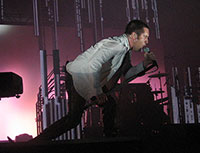
In the early 1980s, industrial rock found its way to the United States. Early American industrial bands such as Ministry also used heavy amounts of noise and distortion in their music. One of the most prominent industrial musicians in the United States during the late 1980s and 1990s was Trent Reznor, who recorded under the name Nine Inch Nails. His first album, Pretty Hate Machine, was released in 1989. Reznor created the album himself, manufacturing all of the sounds on a synthesizer, overdubbing all of the sounds in the recording studio, and layering recordings of his own voice.
Unlike the music of industrial groups such as Throbbing Gristle and Ministry whose music was large free-form, Reznor used melodic riffs and recognizable song structures such as verse-chorus in his music. The single "Head Like a Hole ♫" mixes the noisiness and distortion of earlier industrial rock with a melodic vocal line and a verse-chorus form. "Head Like a Hole ♫" is one of the first Nine Inch Nails to include the line "you're going to get what you deserve," which has become a repeating textual theme in many of Reznor's songs.
In both his music and his personal life, Reznor demonstrates for a fascination with the gruesome and grotesque. His songs often depicted themes of torture and alienation. The music video for "Happiness in Slavery ♫" (1992) depicts a man being tortured, which Reznor claimed was a representation of how he felt his record label TVT was treating him. The video for "Happiness in Slavery ♫" was banned by MTV, as were a number of other Nine Inch Nails videos. Reznor purchased the home in which Charles Manson and his followers murdered actress Sharon Tate and her friends during the 1960s, and he recorded the album The Downward Spiral (1994) there.
The Downward Spiral is a concept album that addresses the deterioration of a suicidal man. The album is unified with ideas of nihilism, in particular the philosophies of Friedrich Nietzsche. Reznor even quoted Nietzsche in the chorus of the song "Heresy ♫": "Your god is dead and no one cares if there is a hell. I'll see you there." Unlike Pretty Hate Machine, in which Reznor performed all of the sounds on the album, he involved several guest artists in the recording of The Downward Spiral. The most successful single from The Downward Spiral was "Closer ♫," which was heavily censored for radio airplay and whose music video was explicit, controversial, and extremely popular.


“In the '90s, the radio was still alive with all different kinds of points of view, and I think that's why people are longing for that time. It was the first time that alternative music broke through to the mainstream.”

