
Overview
By the early 1990s, hip-hop had become a major commercial and artistic force in the United States. The music continued to grow and diversify in both style and geography. Although New York had been the center of hip-hop’s development since the 1970s, in the early 1990s, the West Coast became the new hot spot for hip-hop. Soon, New York artists reestablished the significance of the East Coast in hip-hop. In this lesson, we will consider the musical styles of the East and West Coasts in the 1990s, and then we will turn to the feud between the two coasts that culminated in the murders of two young rappers who were at the heights of their careers.
Objectives
- Recall the musical style that defined West Coast hip-hop, in particular the production style of Dr. Dre
- Identify the significant musicians in the new style of East Coast hip-hop
- Recall the feud between East Coast and West Coast hip-hop artists and the roles played by Tupac Shakur and the Notorious B.I.G. in that feud
East Coast vs. West Coast
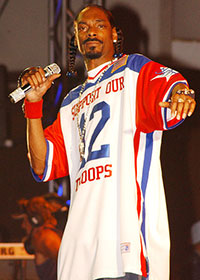
West Coast hip-hop in the early 1990s often featured Dr. Dre's definitive G-funk style of production, and this style of production as well as the appealing music of artists such as Dr. Dre, Warren G, and Snoop Dogg made West Coast hip-hop the most popular style of hip-hop during the early 1990s. As artists such as Nas and the Wu-Tang Clan revived the East Coast hip-hop scene, a feud between rappers from both sides of the country developed.
The first single recorded in the rivalry between East and West Coasts was the 1991 track "F--- Compton♫," recorded by Bronx rapper Tim Dog. In the song, Tim Dog criticized the Los Angeles rap scene, and the members of N.W.A. in particular. The music video featured Tim Dog and others acting in a menacing way toward actors who strongly resembled the members of N.W.A.
A number of West Coast rappers recorded singles in response to "F--- Compton ♫," and the most famous of these responses is Dr. Dre's F--- wit Dre Day (And Everybody's Celebratin) ♫," from The Chronic. Like the other music on The Chronic, "F--- wit Dre Day" has a bass line borrowed from a Funkadelic song and synthesizers playing in a high register. In the track, Dr. Dre responds to Tim Dog and also criticizes other rappers, including Eazy-E, his former fellow member of N.W.A.
Record companies and producers were also involved in the East Coast / West Coast conflict. In 1991, the West Coast record label Death Row Records was founded by Dr. Dre, entrepreneur Suge Knight, and several other musicians and businesspeople. Dr. Dre's The Chronic was the first hit album for Death Row Records, and the label also handled artists including Snoop Dogg, Daz Dillinger, and Tupac Shakur. Two years later, Sean Combs founded Bad Boy Records in New York, and some of the most successful artists on Bad Boy Records included Craig Mack and the Notorious B.I.G. The CEOs of the two labels feuded openly. For example, Knight openly criticized Combs for what he saw as Combs's over-involvement in the music he produced; as a producer, Combs would often provide ad-libbed vocal interjections in artists' tracks, and he often appeared in their music videos.
For the most part, the skirmishes between East and West Coast rappers were limited to music and did not involve real violence. Unfortunately, this changed in 1994, when Tupac Shakur alleged that the Notorious B.I.G. and Sean Combs attempted to murder him. After first surveying the music and careers of Tupac and the Notorious B.I.G., we will then return to the conflict and its deadly consequences for these two rappers.

"I feel like your city - with hip hop in particular, because we're always beating our chest and shouting where we're from - your city is just as influential as your parents. Even the grimy, hardcore gangster rap from New York - KRS-One and Wu Tang, the stuff acknowledges it."


