
Overview
By the 1990s, country music had become the most popular and bestselling genre of music in the United States. In this lesson, we will consider how and why country music rose to commercial dominance in the late 1980s and 1990s. The so-called “new country” music of the 1980s was actually in many ways a revival of older, traditional styles of country music. By the 1980s, a number of the top country stars such as Dolly Parton had become increasingly pop-oriented in their sounds and musical styles. The 1980s saw a return to the earlier days of country music, including the fashion, instrumentation, and lyric themes.
Objectives
- Recall how and why George Strait and Reba McEntire were important figures in the “new” country of the 1980s
- Recall the significance of Garth Brooks’s musical style and lyric message and how he was similar to and different from other country artists
- Examine the careers of other popular country artists from the 1990s, including LeAnn Rimes and Shania Twain
Garth Brooks
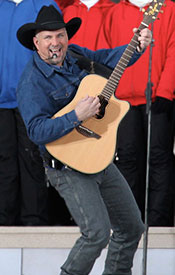
Garth Brooks was the best-selling male musician of the 1990s (pop singer Mariah Carey was the best-selling female musician of the decade). In 1992, NBC aired a Garth Brooks television special at the exact same time that CBS was airing a Michael Jackson television special; Brooks's special was in the top ten of the most popular programs that week, trouncing Jackson's special in the ratings. As of this writing, only Elvis Presley and the Beatles have sold more albums than Garth Brooks in the United States.
Brooks's sound and look was heavily indebted to traditional country music. He told an interviewer, "No one could doubt that we did country music. One thing was who I surrounded myself with: two guys from Kansas, three from Oklahoma. Out in front you've got steel guitar, fiddle, you got hats, we're all wearing Wranglers and Ropers."
To Brooks, he and his music were authentic because they were wearing the requisite jeans, boots, and cowboy hats, and they had the traditional instruments heard in country music. At the same time, Brooks was influenced as much by Merle Haggard and George Jones as he was by Kiss and Lynyrd Skynyrd. He combined the instrumentation and dress of traditional country music with the arena rock aesthetic of 1970s bands, often including pyrotechnics, dramatic lighting effects, smoke, and wires that suspended him over the audience during his live shows.
Brooks recorded a number of songs about traditional country music topics, such as heartbreak, loneliness, and aging. His first single was "Much Too Young (To Feel This Damn Old) ♫" (1989), which Brooks wrote from the perspective of an aging rodeo cowboy. The version on this page is by Brooks Jefferson. In 1990, Brooks released "Friends in Low Places," the first single from his second album, No Fences. "Friends in Low Places" was written by the Nashville songwriting team of Earl Bud Lee and Dewayne Blackwell. The song includes electric guitar, fiddle, and pedal steel guitar, and the vocal range is extremely wide compared both to other country songs and to songs in other genres of music. In addition, Brooks is backed by several vocalists in the chorus, which helps to evoke the "friends" of the song's title. At one point in the recording, one of the vocalists opened a beer can, and the engineers chose to leave the sound in the final recording. "Friends in Low Places" became an anthem for those who saw themselves in contrast to the champagne-consuming, ivory tower-dwelling members of high society; the song praised those who were "not big on social graces" but still celebrated friendship and loyalty of like-minded people. As critic Chuck Klosterman wrote, "Garth told stories about blue-collar people who felt good about what their bad life symbolized."

"Country music is still your grandpa's music, but it's also your daughter's music. It's getting bigger and better all the time and I'm glad to be a part of it. "


