
Overview
Around the turn of the twentieth century, several styles and genres of music came together, and the city of New Orleans provided the catalyst for the formation of jazz. The earliest style of jazz, and one that remained popular for decades after its inception, was called Dixieland. Dixieland, like other types of jazz, allows us the chance to look at many issues of musical, racial, and commercial issues in the first quarter of the twentieth century.
Objectives
- Examine the predecessors of jazz and the diversity of styles and genres that combine in order to create the earliest jazz
- Identify the instruments, musical form, and performance style of Dixieland jazz
- Examine how the issues of race affected the earliest commercial distributions of jazz
- Identify the key figures and songs in Dixieland jazz
Introduction
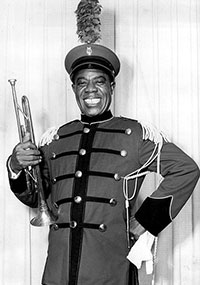
Jazz was born in New Orleans, a city with a rich cultural and ethnic heritage. Jazz emerged as the combination of ragtime syncopation, marching band instrumentation, 12-bar blues forms and instrumentation, and theater orchestras. New Orleans, a port city, also had an active nightlife, and jazz served as the soundtrack for its after-hours goings-on. Plus, in New Orleans, blacks, whites, Creoles, Creoles of colora term for people of mixed African and French heritage (a term for people of mixed African and French heritage), people of Spanish heritage, and people of French heritage, to name just a few, mingled freely. The cultural exchange and melding was crucial to the formation of jazz.
One of the most famous jazz musicians of all time, Louis Armstrong, began his career as a Dixieland jazz musician, and Dixieland remained one of his favorite types of music to play for the rest of his life.
Other musicians, such as Buddy Bolden, Joe Oliver, Sidney Bechet, and Jelly Roll Morton, were also key figures in the formation of early jazz.
Although we know which musical components combined during the formation of jazz, we still are unsure about the origins of the term "jazz" itself. The word "jazz" is surrounded with speculation and conjecture, incidentally. One theory is that it is a Creole word meaning "to speed up" any process or activity. Another theory claims that "jazz" is a corruption of the bawdy Elizabethan word "jass," meaning "to copulate with." Yet another theory is that "jazz" is Cajun argot for "jazz-belle," a corruption of the Biblical figure Jezebel. The origin of the term may be uncertain, but it is clear that the term "jazz" certainly did not originate from polite activities or high society.



